
Packing for Mixed Climates Without Doubling Your Bag Size
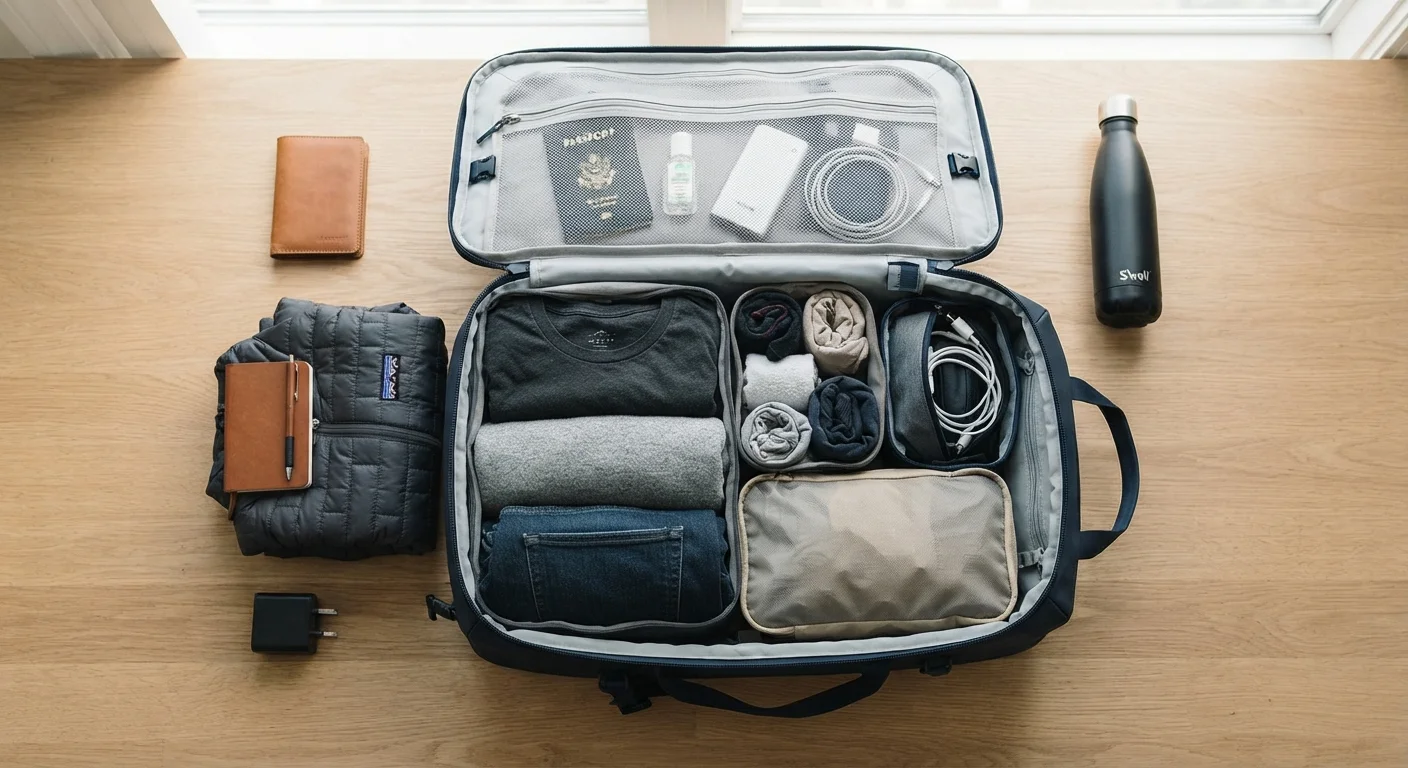
Photo credit: InsightsGrove.com | Discover Joy In Reading
In this article
Strategies for handling temperature swings and unpredictable weather during a trip without resorting to an oversized bag.
Key Takeaways
- Layering with versatile, lightweight pieces beats packing separate outfits for each climate zone.
- Merino wool and synthetic fabrics regulate temperature and dry fast, reducing how much you need to carry.
- A mid-layer like a packable jacket does the heavy lifting across both warm and cold conditions.
- Planning your laundry strategy frees you from packing duplicate items for multi-week trips.
- Avoiding checked bag fees starts with disciplined clothing choices before you ever open your bag.
Why Mixed-Climate Trips Break the Packing Brain
A week in the Pacific Northwest followed by a desert road trip. A coastal city with morning fog and afternoon sun. An international itinerary that swings from humid lowlands to chilly mountain towns. Mixed-climate travel is the norm, not the exception — but most packing advice assumes stable weather.
The knee-jerk response is to pack for everything: a fleece and a raincoat and shorts and jeans. Before you know it, you're hauling a checked bag on a trip that should have been a carry-on. That costs real money in airline fees and lost flexibility at the destination.
The fix isn't to pack less comfort — it's to pack smarter systems. See our first-time budget packing guide if you're starting from scratch, then use the practices below to handle the climate complexity.
Best Practices for Mixed-Climate Packing
These practices work together as a system. None of them alone is revolutionary — applied together, they routinely keep a two-week, multi-climate trip inside a 40-liter carry-on.
Build your clothing list around a three-layer system, not individual outfits.
A base layer, mid-layer, and outer shell cover an enormous temperature range without duplicating function. Each piece justifies its weight by working across multiple conditions rather than serving a single use case.
Choose fabrics that regulate temperature and dry overnight.
Merino wool and moisture-wicking synthetics perform across a wider temperature range than cotton and can be hand-washed and dried by morning. This dramatically reduces how many items you need in the bag.
Designate one packable, compressible outer layer as your climate buffer.
A single packable jacket — whether down-filled for dry cold or a waterproof shell for rain — collapses to near nothing in your bag and handles most climate surprises. Carrying both adds weight that rarely pays off.
Plan your laundry stops before you pack, not as an afterthought.
Knowing you'll access a laundromat or sink-wash on day four lets you pack for four days instead of ten. This single mental shift cuts clothing volume roughly in half on longer trips.
Limit footwear to two pairs maximum, chosen for cross-use.
Shoes are the densest, least compressible items in any bag. Each additional pair takes space that could hold an entire day's worth of clothing. Choosing shoes that work across multiple contexts — walking, casual dining, light hiking — eliminates the need for extras.
For a deeper look at how clothing selection anchors this strategy, the capsule wardrobe approach is worth reading alongside this guide.
What to Stop Believing About Weather Prep
A lot of overpacking stems from fear-based logic: what if it's colder than the forecast? What if I need a second pair of shoes? These anxieties are understandable, but they consistently lead to bags that cost more to fly with and more to carry around.
Don't Pack for the Worst-Case Forecast
Most weather anxiety in packing comes from imagining the coldest possible day rather than the most likely conditions. A layering system handles a 20-degree temperature swing without requiring separate cold-weather and warm-weather wardrobes. Reserve worst-case packing for genuinely extreme environments — not a city that might dip into the 50s one evening.
Weather apps have improved dramatically. Checking a 10-day forecast before finalizing your packing list — not weeks in advance — gives you actionable information rather than worst-case planning. If you're traveling during shoulder season, when weather is least predictable, build your layering system around that uncertainty rather than packing for every possible scenario. The shoulder season trade-offs guide covers what to realistically expect.
Also worth confronting: the belief that a bigger bag means better preparation. Common packing myths like this one have real costs — financially and physically.
Keeping Costs Down From the Start
Packing light for mixed climates isn't just about comfort — it's directly tied to how much your trip costs. Checked bag fees vary by airline but can add $30–$70 each way on domestic routes and more internationally. A single overstuffed bag on a round trip can erase what you saved on the base fare.
$60–$140
Typical round-trip checked bag fee on domestic flights
Airline checked bag fees vary by carrier and fare class; many budget carriers charge for the first checked bag on both outbound and return legs.
40L
Carry-on bag capacity most airlines allow
A 40-liter bag fits within most major US airline carry-on size limits, though travelers should verify current policies with their specific carrier before flying.
The travel money tips hub covers the full picture of trip-cost management, but bag fees are one of the most controllable line items. Mastering mixed-climate packing is, in practice, a money skill as much as a logistics one. For an end-to-end resource, the complete guide to travelling light ties all of these threads together.

Author
Travel Smarter Editorial Team
Travel Smarter Editorial Team is the collective byline for our editorial team and contributor network. Articles published under this byline or an editorial pen name are researched, written, and reviewed according to our editorial standards for clarity, consistency, and independence before publication.
View all articles →