
The Complete Guide to Travelling Light on Any Budget
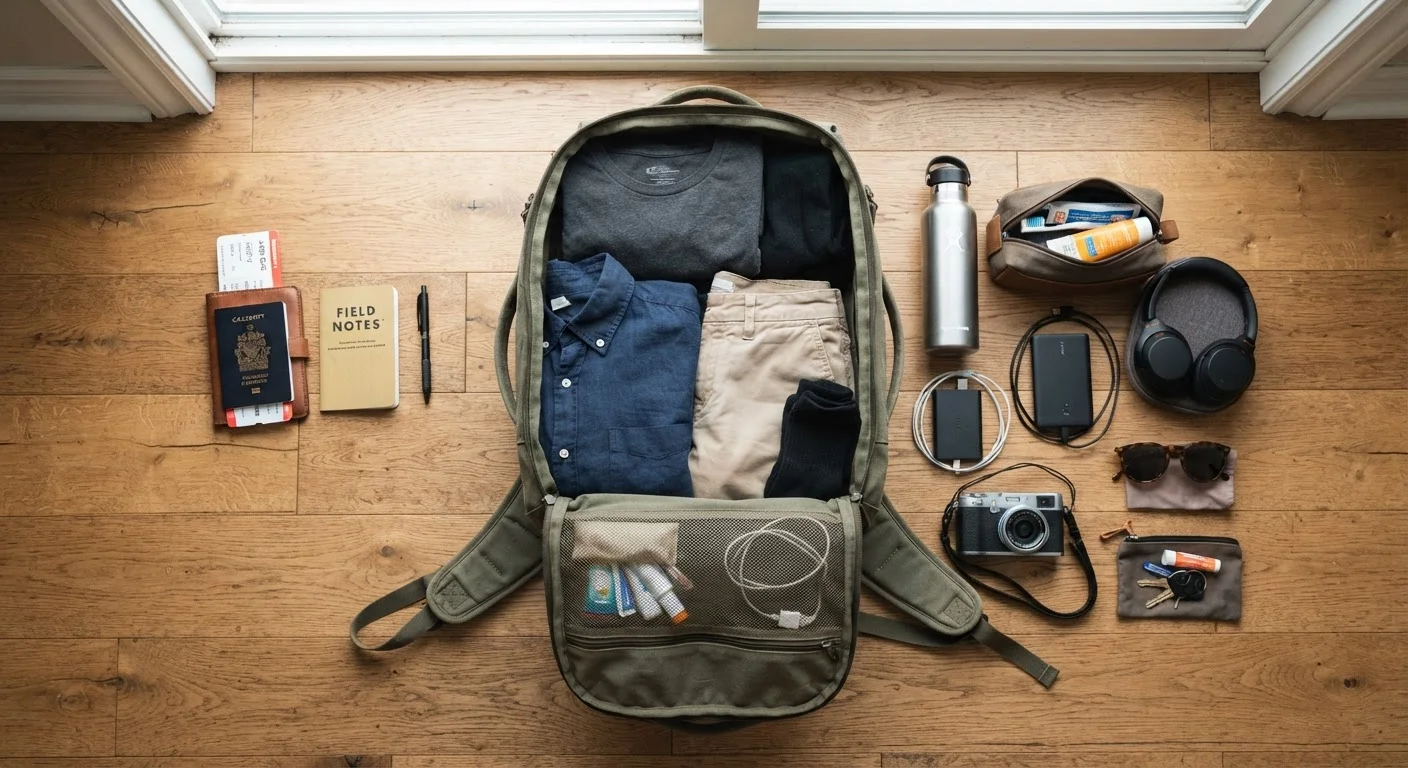
Photo credit: InsightsGrove.com | Discover Joy In Reading
In this article
An end-to-end resource covering bag selection, packing methods, clothing strategy, toiletries, and avoiding common fee traps.
Key Takeaways
- Skipping checked bags can save $50–$100+ per round trip on budget carriers.
- A 40-liter or smaller bag fits most airlines' personal item or carry-on rules.
- A seven-piece mix-and-match wardrobe can cover a two-week trip with laundry.
- Solid toiletries and travel-size decants eliminate liquid restrictions and bulk.
- Rolling clothes and using packing cubes maximises space and reduces wrinkles.
- Always verify bag size limits with each airline before you fly — they vary widely.
Why Packing Light Saves Real Money
Budget airlines have turned baggage fees into a significant revenue stream. Checked bag fees on domestic and international routes can add $30–$60 per bag, per direction — and that's before overweight surcharges kick in. On a round trip, a single checked bag can cost as much as the base fare itself.
Travelling light eliminates those fees entirely and opens up other savings: you can use cheaper ground transport (no struggling with a 30kg case on a bus), move between accommodations more freely, and avoid the hidden cost of time — queuing at check-in, waiting at baggage claim, or paying for hotel storage on check-out day.
For a broader look at where baggage fits within your overall travel budget, see planning affordable travel end-to-end.
$50–$100+
Typical round-trip checked bag cost on budget airlines
Based on published fee ranges from major US budget carriers; exact fees vary by route and booking timing.
40L
Maximum carry-on size that fits most airline policies
Many US and international carriers allow bags up to approximately 40 liters in overhead bins; always verify with your specific airline.
7–8 pieces
Clothing items sufficient for a two-week trip with laundry
Based on standard capsule wardrobe frameworks used by minimalist travel practitioners.
Choosing the Right Bag
The single most important gear decision is your bag's size. Most major carriers allow a personal item (roughly 18" × 14" × 8") for free, and some budget carriers charge separately for anything that goes into the overhead bin. A 25–40 liter pack that meets the smaller personal item dimensions is the sweet spot for trips up to two weeks.
Look for a bag with a clamshell opening (easier to pack and access), a hip belt if you'll carry more than 7kg, and compression straps to cinch down half-empty loads. Internal organisation panels help keep things findable without unpacking everything.
Before you buy any bag, measure the interior capacity in liters and compare it directly against your target airline's carry-on dimension rules — not just the brand's marketing claim.
Bag manufacturers measure dimensions differently, and a bag marketed as 'carry-on compliant' may exceed the limits of budget carriers with stricter policies.
Pack your bag fully, then take out three items you feel uncertain about. On almost every trip, at least two of those items will have been unnecessary.
Overpacking is almost always driven by low-probability 'what if' scenarios. Editing before you leave is faster than suffering with extra weight throughout the trip.
If you're deciding between a backpack and a wheeled carry-on, consider your destination's terrain. Cobblestone streets and stairs make wheels a liability; airports and hotels make them an asset. For a first trip, a structured daypack-style carry-on often works best. Our first-time budget flyer packing guide covers bag selection in more detail.
Building a Lean, Versatile Wardrobe
The core of light packing is a capsule wardrobe — a small set of items that mix and match into many outfits. For a two-week trip, a reasonable baseline is: three to four tops, two bottoms, one layer (light jacket or hoodie), one pair of versatile shoes, and one pair of sandals or packable flats. That's seven to eight pieces total.
Fabric matters. Merino wool and synthetic blends dry overnight, resist odour between washes, and pack smaller than cotton. A single merino t-shirt can be worn two or three times before washing without noticeable odour — a genuine functional advantage, not marketing language.
Neutral colours (navy, grey, black, olive) are easier to mix and match and show stains less. Avoid packing "just in case" items for scenarios that are unlikely or can be solved cheaply at the destination. As we explore in common packing myths, the "I might need it" mindset is the primary cause of overpacking.
Avoid Packing for Worst-Case Weather
It's tempting to pack for every possible weather scenario — a heavy rain jacket, a warm layer, and a light layer for a trip that's forecast to be mild. This triples your clothing weight for situations that may never arise. Check a reliable weather forecast close to your departure date and pack for the most likely conditions. A compact packable rain layer handles most scenarios without the bulk.
Packing Methods That Actually Work
Two methods consistently outperform casual folding: rolling and bundle wrapping. Rolling clothes tightly reduces volume and makes items visible without digging. Bundle wrapping (wrapping garments around a central core) virtually eliminates wrinkles — useful if you're mixing business or smart-casual occasions into your trip.
Packing cubes are a practical tool for organisation rather than compression. They don't shrink your clothes, but they create distinct zones in your bag — one cube for tops, one for bottoms — so you can pull out exactly what you need. Compression bags add real density reduction for bulky items like fleeces.
Always pack your heaviest items (shoes, electronics) closest to your back and lowest in the bag. This keeps weight distribution stable whether you're walking or lifting into an overhead bin. For a complete carry-on-only walkthrough, see how to pack your whole trip into one bag.
Toiletries Without the Bulk
Toiletries are one of the heaviest and most space-inefficient parts of most bags. The standard approach — full-size bottles — adds weight, risks leaks, and may trigger security confiscation under the 3-1-1 liquid rule (containers must be 3.4 oz/100ml or less, all fitting in one quart-size bag).
Solid alternatives — shampoo bars, solid conditioner, solid sunscreen, and toothpaste tablets — bypass the liquid rule entirely, weigh less, and often last longer per ounce. Decanting liquids you can't replace in solid form into small reusable silicone bottles keeps volume controlled.
Don't pack toiletries you can buy cheaply at your destination. Sunscreen, shampoo, and toothpaste are available almost everywhere. The only items worth carrying from home are prescriptions, contact lens solution (if your brand isn't available abroad), and skincare products you rely on.
Buy Toiletries on Arrival When Possible
In most destinations, basic toiletries cost roughly the same as at home and are widely available at pharmacies or convenience stores near transport hubs. Skipping them from your pack saves meaningful weight and eliminates liquid-rule stress at security. Reserve packing space for items you genuinely can't source locally.
Avoiding Common Fee Traps
Bag fees are the obvious cost, but there are subtler traps. Many budget carriers charge more for carry-on bags booked after the initial fare purchase — so if you know you'll want overhead bin access, select it at checkout, not later. Some airlines also weigh carry-ons at the gate, not just checked bags.
Overpacking electronics is another common issue. A laptop, tablet, e-reader, camera, and multiple chargers add up fast in both weight and security hassle. Consolidate: a smartphone covers most functions a tablet does, and a travel adapter with multiple USB ports replaces individual chargers.
Finally, checked-bag fees at airports are always higher than fees added during online booking. If you're travelling with others and think you might share a checked bag, confirm the airline's policy on shared baggage before assuming it's allowed. Always read the airline's specific baggage policy before booking — they vary significantly and change frequently.
For your complete pre-departure checklist, including documentation and currency prep, visit our pre-departure planning checklist. And if you're heading to Europe on a tight budget, see how the math works for affordable European travel.
Verify Bag Rules With Your Airline Directly
Airline baggage policies — including size limits, weight allowances, and fees — change frequently and vary significantly between carriers and even between fare classes on the same airline. Do not rely on general guides (including this one) as your final source. Check your specific airline's baggage policy page after booking and again before you travel.

Author
Travel Smarter Editorial Team
Travel Smarter Editorial Team is the collective byline for our editorial team and contributor network. Articles published under this byline or an editorial pen name are researched, written, and reviewed according to our editorial standards for clarity, consistency, and independence before publication.
View all articles →