
Decoding Marketing Language: What 'Premium', 'Professional', and 'Advanced' Really Mean
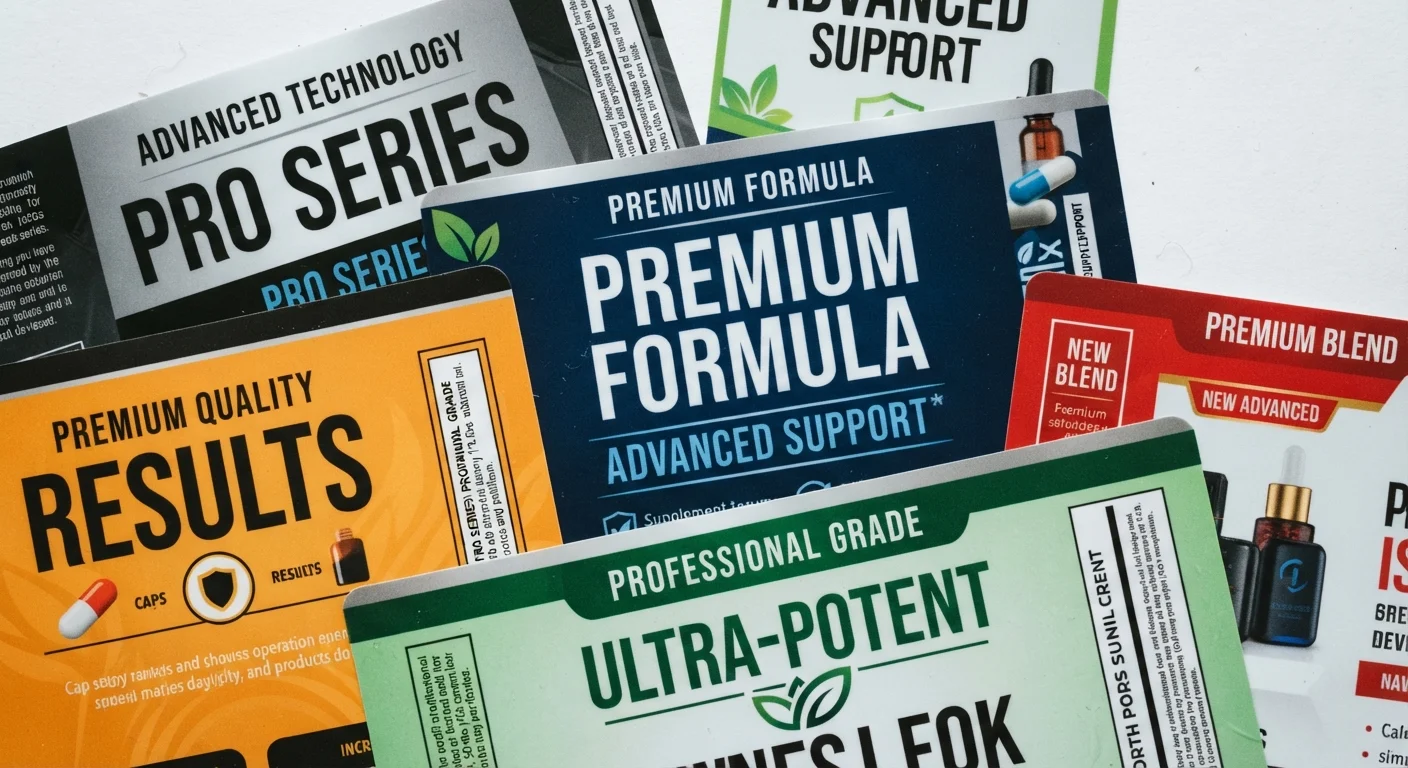
Photo credit: InsightsGrove.com | Discover Joy In Reading
These words sound impressive but carry no standard definition. Learn to look past the label and focus on verifiable attributes instead.
Key Takeaways
- Terms like 'premium,' 'professional,' and 'advanced' have no standardized or regulated definitions in product marketing.
- Verifiable specs, certifications, and third-party test data are more reliable quality signals than label language.
- Price markups attached to these words aren't evidence of added value - they're a marketing strategy.
- Learning to read past buzzwords helps you compare products on objective, measurable attributes.
The Words That Sound Official but Aren't
Walk down any retail aisle - or scroll through any product listing - and you'll encounter a consistent vocabulary: premium, professional, professional-grade, advanced, enhanced, ultra. These words feel like they mean something. They suggest expertise, higher standards, or superior materials. But none of them are regulated, standardized, or independently verified by any consumer protection body in the United States.
Unlike terms such as "USDA Organic" or "UL Listed" - which require third-party verification - marketing descriptors like "premium" exist entirely at a manufacturer's discretion. A company can apply the word to any product with no required testing, no minimum spec threshold, and no external audit. This isn't a gray area; it's a well-documented feature of how brand language works.
For budget-conscious shoppers trying to get real value, this matters. Understanding what these words can't tell you is the first step toward focusing on what actually can. See our plain-language shopping glossary for more on the terminology you'll encounter when spending more wisely.
Myth
If a product is labeled 'professional' or 'professional-grade,' it meets a higher technical standard than consumer versions.
Fact
The term 'professional' is unregulated in consumer product marketing and does not require any specific performance threshold or independent certification.
In regulated trades - licensed electricians, credentialed medical staff - 'professional' carries meaning because it's tied to licensing requirements. In retail product labeling, it carries none. A company applying "professional-grade" to a tool, cleaning product, or personal care item does so voluntarily, with no required test to pass. The word signals a target customer (someone who sounds serious) rather than an objective spec. Always ask: professional by whose standard, verified by whom?
Myth
'Premium' products always use higher-quality materials or components than standard versions.
Fact
Premium is a self-designated marketing term. In many documented cases, 'premium' and 'standard' variants of the same product share identical components.
Product line differentiation is a common retail strategy. A manufacturer may produce two variants with near-identical internal specs, price one higher, and apply 'premium' branding to justify the gap. Consumer product journalists and watchdog organizations have documented instances of this across categories from audio cables to skincare to packaged food. The reliable way to check: compare ingredient lists, material disclosures, or component specs directly between SKUs rather than relying on tier names.
Myth
'Advanced' on a product label means it incorporates newer or significantly improved technology.
Fact
'Advanced' is purely descriptive marketing language with no external definition - it does not confirm that any specific technological improvement exists.
Manufacturers can label a product 'advanced' whether it was redesigned last year or a decade ago. The word creates a perception of innovation without requiring it. If technological improvement matters for your purchase decision, look for version history, model-year comparisons, or third-party benchmark tests. Changelog data from the manufacturer - or teardown analysis from independent technical reviewers - will tell you far more than the product name will.
Myth
A higher price on a 'premium' product is evidence that it costs more to make.
Fact
Retail pricing reflects brand strategy, market positioning, and perceived value - not necessarily production cost or measurable quality differences.
Cost-plus pricing is one model, but it's far from the only one. Premium pricing - charging more to signal quality rather than to recover higher costs - is a well-established strategy. A product positioned as premium may carry a margin multiple times higher than a functionally similar product without the label. This doesn't make it a bad purchase in every case, but it does mean that price alone cannot validate a quality claim. Evaluate the spec, not the sticker.
Myth
Terms like 'clinical strength' or 'doctor-recommended' on health products signal regulatory approval or clinical testing.
Fact
These phrases are marketing descriptors and do not indicate FDA approval, clinical trial evidence, or endorsement by any medical body unless explicitly documented.
'Doctor-recommended' typically refers to surveys or paid partnership arrangements, not independent clinical endorsement. 'Clinical strength' usually describes a concentration level - one that may or may not be meaningfully different from standard versions. For health and personal care products, check the active ingredient percentage listed in the Drug Facts panel (for OTC products) or the ingredients list. Consult a qualified healthcare professional for guidance on what concentration or formulation is appropriate for your situation. General health information like this is not a substitute for personal medical advice.
How to Find the Signal Behind the Noise
Once you recognize that label language is subjective, the next step is knowing where to find objective data instead. Here's a practical framework:
- Look for measurable specs. Instead of "advanced motor technology," find the RPM rating, wattage, or torque spec. Numbers can be compared; adjectives can't. For electronics especially, verifiable specs are the only reliable baseline. TV resolution and refresh rate claims are a textbook example of how spec language gets distorted.
- Seek third-party certifications. Look for marks from recognized testing organizations - UL, NSF, ASTM, or industry-specific equivalents. These require actual verification, unlike brand-generated language.
- Cross-reference product tiers. Many manufacturers sell nearly identical products under different names at different price points. Check the model numbers and spec sheets side by side, not just the product names.
- Use independent review sources. User forums and professional reviews answer different questions - combine both for a fuller picture.
0
Regulated definitions for 'premium' in US consumer product law
Neither the FTC nor any US standards body has established a legal definition requiring 'premium,' 'professional,' or 'advanced' labels to meet specific product criteria.
~60%
Shoppers who say label language influences perceived quality
Research in consumer behavior consistently finds that descriptive product names and tier labels meaningfully affect perceived quality, even when underlying products are identical.
It's also worth noting that a higher price does not validate a "premium" label. Manufacturers can set any retail price they choose. Anchor pricing and sale mechanics work alongside aspirational label language to make ordinary products feel exceptional - and expensive. Separating those two tactics gives you a clearer read on actual value.
Don't Let Packaging Language Replace Spec Research
When a purchase decision rests on durability, safety, or performance, label descriptors are the least reliable input you have. Build your evaluation around measurable attributes: materials listed, independent test results, and verified certifications. If a product can't point to any of those, the label is doing all the work - and that's a red flag, not a reassurance.
Apply the same skepticism across categories. Whether you're evaluating tools, skincare, kitchen appliances, or car-care products, the category buyer guides framework consistently points back to the same principle: define what quality means in measurable terms for that specific product type, then verify whether the product meets those criteria - regardless of what it calls itself.

Author
Savvy Shopping Editorial Team
Savvy Shopping Editorial Team is the collective byline for our editorial team and contributor network. Articles published under this byline or an editorial pen name are researched, written, and reviewed according to our editorial standards for clarity, consistency, and independence before publication.
View all articles →