
Private Seller, Dealership, or Auction: Weighing Your Buying Options
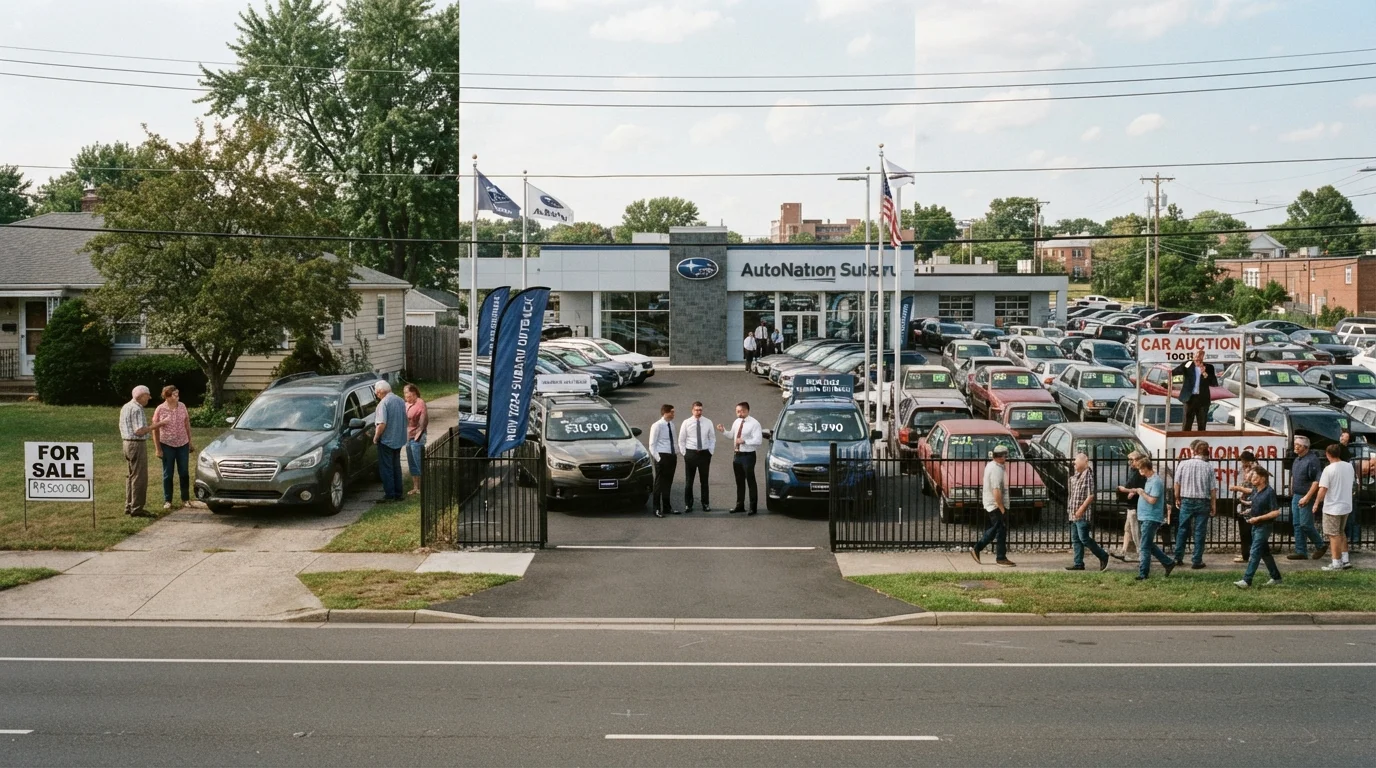
Photo credit: InsightsGrove.com | Discover Joy In Reading
In this article
Each used car buying channel carries different risks, protections, and price dynamics. Here's how to weigh them before deciding where to shop.
Key Takeaways
- Private sellers typically offer lower prices but provide fewer legal protections than dealerships.
- Dealerships carry more buyer safeguards and financing options, usually at a higher sticker price.
- Auctions can yield genuine bargains but give little time for inspection and carry significant risk.
- No channel eliminates the need for an independent vehicle history check and pre-purchase inspection.
- Your choice of buying channel should match your experience level, budget, and risk tolerance.
Why the Buying Channel Matters as Much as the Car
Most first-time used car buyers focus almost entirely on the vehicle itself - the mileage, the color, the monthly payment - without thinking carefully about where they buy. That's a costly blind spot. The buying channel determines how much legal recourse you have, how much room you have to negotiate, and how much due diligence you're expected to do yourself.
Before you start scrolling listings, it's worth understanding what terms like 'clean title,' 'as-is sale,' and 'salvage history' actually mean in practice - because they apply very differently depending on who you're buying from. This article breaks down the three main channels so you can match your approach to your experience level and risk tolerance.
Private Seller: Lower Price, Less Protection
Buying from a private individual is often the path to the lowest purchase price. Without a dealer's overhead - lot rent, staff, reconditioning costs - sellers can price vehicles closer to their actual market value. That price advantage is real, but it comes bundled with meaningful trade-offs.
Private sales in most US states are treated as "as-is" transactions by default. Once you hand over the money and sign the title, you own the car and any problems that come with it. There's no cooling-off period, no implied warranty, and no dealer license board to file a complaint with. If the transmission fails three days later, your recourse is largely limited to civil court - which is expensive and time-consuming.
Private sellers also can't offer financing, so you'll need to arrange your own loan through a bank or credit union before you shop, or be paying cash.
Always Verify History Before Buying Private
Run a vehicle history report using the VIN before meeting any private seller. This can reveal accident history, odometer rollbacks, title issues, and outstanding liens - problems a seller may not disclose or may not even know about. The cost is typically under $40 and can save you thousands.
What private buying does reward is preparation. Arrange an independent pre-purchase inspection by a trusted mechanic before you commit, run a vehicle history report, and brush up on negotiation tactics that work with private sellers. Sellers in this channel are often more flexible on price than dealers, especially if the car has been listed for a while.
Dealership: More Protection, Higher Price
Licensed dealerships operate under state and federal consumer protection laws that private sellers do not. The Federal Trade Commission's Used Car Rule, for example, requires dealers to display a Buyers Guide on every vehicle disclosing whether it's sold as-is or with a warranty. Many states layer additional protections on top of that.
Dealers also typically recondition vehicles before sale, can arrange on-site financing, and sometimes offer certified pre-owned programs with extended warranties. If you want to understand what those CPO programs actually cover, it's worth reading about certified pre-owned versus standard used before assuming the extra cost is automatically justified.
The trade-off is price. Dealers build margin into their listings to cover overhead and profit. You can often negotiate, but the floor is higher than a comparable private sale. Watch also for add-on fees - documentation fees, dealer prep charges, and optional products like paint protection - that can quietly inflate the final number.
| Private Seller | Dealership | Auction | |
|---|---|---|---|
| Typical price | Often lowest | Higher due to overhead | Variable; can be low |
| Consumer protections | Minimal; usually as-is | State & federal laws apply | Minimal; strictly as-is |
| Financing options | None; arrange independently | On-site financing available | Usually cash or pre-arranged |
| Inspection opportunity | Flexible; schedule your own | Limited but usually allowed | Very limited; minutes only |
| Negotiation room | Often flexible | Possible but floor is higher | Competitive bidding only |
| Risk level for first-timers | Moderate | Lower | High |
Auction: Potential Value, Real Risk
Vehicle auctions - whether physical lanes or online platforms - can surface cars at prices well below retail. Dealers themselves buy inventory this way. However, auctions are structured to move vehicles quickly, and that speed is what creates the risk.
Inspection time is typically measured in minutes, not hours. Many auction vehicles cannot be test-driven at all. Condition reports exist but vary in quality, and 'as-is' terms are almost universally enforced. You're also competing with professional buyers who have mechanical expertise and can read a car faster than most consumers.
Auction Bidding Is Hard to Undo
At most vehicle auctions, a winning bid is a binding commitment to purchase. There's no inspection contingency and no return policy. If you haven't set a firm maximum bid in advance - factoring in potential repair costs - it's easy to overpay in the heat of competitive bidding. Treat auction buying as a strategy for experienced, cash-ready buyers only.
For a buyer focused on protecting themselves through careful process, auctions represent the highest-risk channel. If you do explore this route, set a firm ceiling price before bidding, factor in reconditioning costs, and understand that some auction platforms restrict who can participate to licensed dealers.
Understanding how depreciation affects used car pricing can also help you spot whether an auction price is genuinely below market or simply reflects a vehicle that nobody else wanted to bid on.
Making the Call: Matching Channel to Buyer
There's no universally correct channel. Your decision should be driven by three honest self-assessments: your mechanical knowledge, your risk tolerance, and your budget flexibility.
- Low mechanical knowledge, risk-averse: A dealership provides the clearest protections and the easiest financing path, even if you pay a premium for that safety net.
- Moderate knowledge, willing to do homework: A private seller can offer real savings if you're disciplined about inspection and history checks. Budget for a pre-purchase inspection and treat it as non-negotiable.
- Strong mechanical knowledge, cash reserves: Auctions can make sense, but only if you're genuinely equipped to evaluate a vehicle quickly and absorb potential repair costs without financial strain.
Whichever channel you choose, the underlying logic for comparing cars - especially weighing age, mileage, and cost profile - stays the same. The article on buying older versus newer used cars walks through those trade-offs clearly.
This article provides general educational information about used car buying channels. It is not legal or financial advice. Consult qualified professionals for guidance specific to your situation, and always verify title status and vehicle history through official records before completing any purchase.

Author
Car Ownership Editorial Team
Car Ownership Editorial Team is the collective byline for our editorial team and contributor network. Articles published under this byline or an editorial pen name are researched, written, and reviewed according to our editorial standards for clarity, consistency, and independence before publication.
View all articles →