
Sound Bar vs. Stereo Speakers for a Small Room
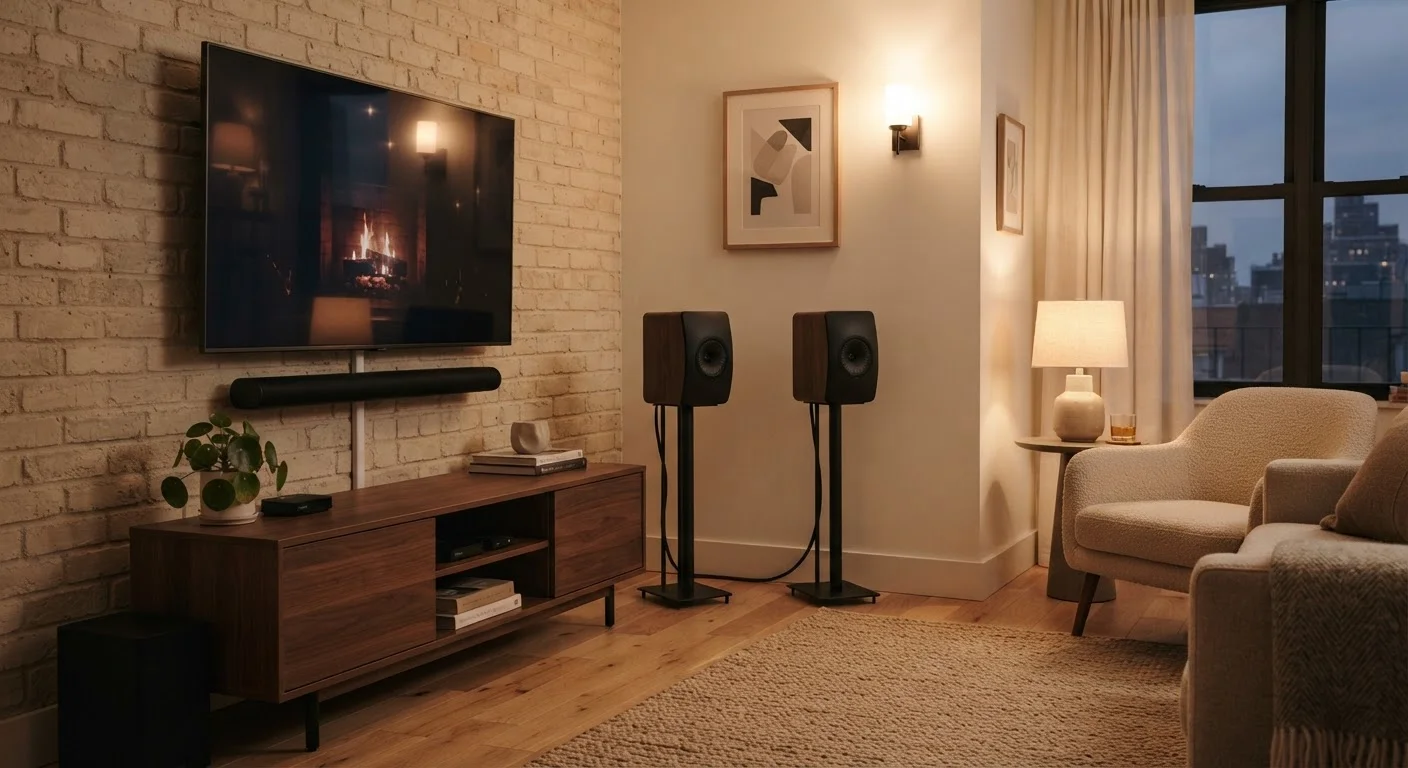
Photo credit: InsightsGrove.com | Discover Joy In Reading
In this article
Room size, source content, and budget all shape which audio setup makes sense. Here's how to think through the decision.
Key Takeaways
- Sound bars excel at simplicity, wall-mount compatibility, and dialogue clarity for TV viewing.
- Stereo speakers generally produce wider soundstage and more accurate music reproduction.
- Small rooms can actually work against large speaker setups due to bass buildup and reflections.
- Wiring, furniture layout, and renter restrictions are practical factors that often settle the debate.
- Budget shapes what you actually get in each category - entry-level options differ significantly in performance.
What Each Setup Actually Involves
A sound bar is a self-contained speaker array - typically a long horizontal enclosure housing multiple drivers - designed to sit below or mount beneath a TV. Most include built-in amplification and connect via HDMI ARC, optical cable, or Bluetooth. Some come with a separate subwoofer. Setup is usually straightforward enough to complete in under 30 minutes.
Stereo speakers are a pair of separate enclosures - left and right - each reproducing a distinct audio channel. They require an external amplifier or receiver to drive them. That adds another device, more cabling, and more decisions around placement. Passive bookshelf speakers are the most common entry point; powered (active) bookshelf speakers simplify things by having amplification built in.
For small-space context, it's worth reading the full small-space living guide before committing to either setup - furniture scale and layout often interact with audio gear placement in ways people don't anticipate.
| Criterion | Sound Bar | Stereo Speakers |
|---|---|---|
| Setup complexity | Low - plug and play | Moderate to high - amp + placement required |
| Footprint | Minimal - single unit | Two speakers plus stands or shelf space |
| Wiring | One or two cables | Speaker wire runs plus power cables |
| Soundstage width | Limited by unit width | Wide with proper speaker separation |
| Dialogue clarity (TV) | Strong - center channel optimized | Adequate, not specifically optimized |
| Music reproduction | Decent, processed | More accurate stereo imaging |
| Renter-friendly | Yes | Depends on layout and cable management |
| Upgrade path | Limited - replace the unit | Modular - swap amp, speakers independently |
How Small Room Acoustics Change the Equation
Room size isn't just a space issue - it's an acoustic one. In rooms under roughly 150 square feet, bass frequencies reflect off walls and accumulate in corners, a phenomenon called bass buildup. This can make a subwoofer-equipped sound bar or large floorstanding stereo speakers sound boomy and indistinct, regardless of their list price.
Bookshelf-sized stereo speakers - especially those with rear ports - are sensitive to how close they sit to walls. Ideal placement is often 1-3 feet from the back wall, which is simply not available in many small rooms. A sound bar, mounted flush to the wall or set directly below the TV, sidesteps most of these constraints by design.
That said, stereo imaging - the sense of instruments occupying distinct positions in space - genuinely benefits from proper left-right speaker separation, even in small rooms. If your speakers can sit 6-8 feet apart and form an equilateral triangle with your listening position, you'll hear a soundstage a sound bar cannot replicate.
150 sq ft
Approximate room size where bass buildup becomes audible
Acoustic engineers generally cite small room dimensions as a key factor in low-frequency resonance management.
6-8 ft
Recommended speaker separation for stereo imaging
Standard audiophile guidance suggests an equilateral triangle between speakers and listener for optimal soundstage.
Visual bulk matters too. Two speaker stands in a compact room can affect how spacious the room feels. For more on that dynamic, see why small rooms feel even smaller.
Practical Tradeoffs: Wiring, Renting, and Real-Life Use
For renters, installation limitations are often the deciding factor. Most leases prohibit wall modifications beyond small nail holes. Running speaker wire neatly along baseboards requires cable raceways or adhesive channels, and even then, two cables across a living room create tripping hazards and visual noise. A sound bar eliminates all of that. Renters face different constraints than owners across every category of home setup - audio is no exception.
Powered (active) bookshelf speakers narrow the gap somewhat: they need only a power cable each and a signal source, with no separate receiver. If you use a streaming device like a Chromecast or Apple TV, some powered speakers connect directly via optical or USB. This is the closest a stereo setup gets to sound bar simplicity.
Powered vs. Passive Stereo Speakers
Passive speakers require a separate amplifier or receiver to function. Powered (active) speakers have amplification built in and connect directly to a source. For small rooms and simpler setups, powered bookshelf speakers are often the more practical stereo option - fewer components, less desk or shelf space consumed, and no receiver to configure.
From a pure audio-per-dollar standpoint, stereo speakers have historically offered stronger performance at a given price compared to sound bars in the same range. Sound bars bundle convenience and integration into their cost. Neither is a bad value - they're pricing different things.
Before finalizing any setup, do a quick audit of where speakers would actually sit. The room-by-room small home audit is a useful framework for identifying what space you actually have to work with.

Author
Savvy Shopping Editorial Team
Savvy Shopping Editorial Team is the collective byline for our editorial team and contributor network. Articles published under this byline or an editorial pen name are researched, written, and reviewed according to our editorial standards for clarity, consistency, and independence before publication.
View all articles →