
Lighting Choices That Make a Compact Room Feel Larger
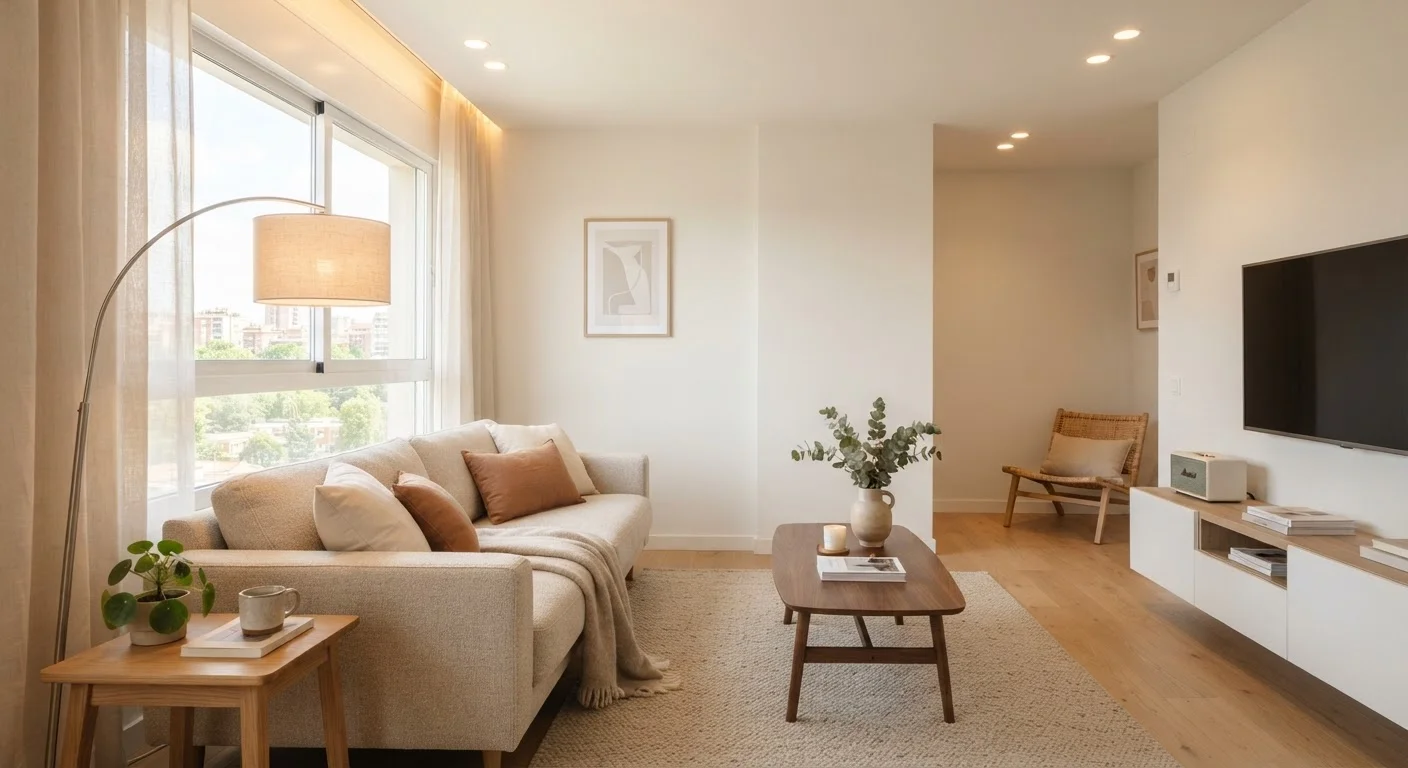
Photo credit: InsightsGrove.com | Discover Joy In Reading
In this article
Natural light, layered artificial lighting, and mirror placement interact in ways that genuinely affect how spacious a room feels. Here's the evidence.
Key Takeaways
- Natural light amplification through window treatments and mirror placement is one of the most effective no-cost tactics.
- Layering multiple light sources at different heights creates depth that a single overhead fixture cannot.
- Color temperature of bulbs - warm vs. cool - affects how enclosed a room feels to the human eye.
- Uplighting draws the eye upward, making low ceilings appear taller than they are.
- Dark corners are the single biggest contributor to a room feeling smaller than its measurements suggest.
Why Lighting Shapes Perceived Space
Room dimensions are fixed. Perceived space is not. Research in environmental psychology consistently finds that brightness and light distribution are among the strongest cues the brain uses to estimate enclosure - often overriding actual measurements. A poorly lit 300-square-foot studio can feel tighter than a well-lit 200-square-foot one.
The underlying mechanism is straightforward: when light doesn't reach room boundaries - walls, corners, ceilings - those surfaces visually recede and the brain registers a smaller volume. Eliminating dark zones is therefore the first objective, not an aesthetic upgrade. If you haven't yet analyzed what's making your space feel constrained, the underlying causes of perceived smallness are worth understanding before making lighting changes.
~30%
Increase in perceived room brightness from mirror placement
Interior design studies generally estimate that well-positioned mirrors can increase the sense of brightness in a room by roughly 30%, though results vary by mirror size and placement angle.
3500K-4000K
Bulb color temperature associated with a more open feel
Lighting researchers and environmental psychologists broadly agree that neutral-white light in this Kelvin range reads as more spacious than warm light below 3000K in enclosed residential spaces.
Maximize Natural Light First
Natural light is the most effective spatial amplifier available, and it costs nothing beyond some thoughtful adjustments. The goal is to let in as much daylight as possible while directing it deeper into the room.
- Swap heavy drapes for sheer panels or cellular shades. Thick curtains absorb and block light even when open. Sheers diffuse daylight across a wider area of the room.
- Hang curtain rods close to the ceiling, not above the window frame. This visually raises the perceived ceiling height and allows light to enter at a higher angle. This principle connects directly to using vertical space effectively.
- Place mirrors on walls adjacent to - not directly across from - windows. Positioning a mirror at a 90-degree angle to a window bounces light sideways into darker areas rather than reflecting it straight back out.
The Mirror Placement Rule Worth Knowing
The common advice to place a mirror directly opposite a window is often counterproductive - it can create glare and bounce light back out rather than distributing it inward. Positioning a mirror on a wall perpendicular to the window (at a 90-degree angle) is generally more effective at spreading daylight across the room. Size matters too: larger mirrors distribute more light than small decorative ones.
Layer Artificial Light at Multiple Heights
A single overhead fixture creates one plane of light. In a compact room, this flattens the space and leaves corners shadowed. Layered lighting - ambient, task, and accent sources at different heights - creates dimension and eliminates the visual compression that shadows cause.
Add a floor lamp or table lamp in every dark corner of the room.
Unlit corners create visual boundaries that shrink the perceived room volume. Illuminating them pushes the visual boundary outward and makes the room read as larger. This is the single highest-impact change most rooms can absorb immediately.
Use upward-facing fixtures (uplights or torchieres) to draw attention toward the ceiling.
When light travels upward and illuminates the ceiling, the eye follows and the ceiling appears higher. This is especially effective in rooms with ceilings under 8 feet, where overhead pressure is a common complaint.
Replace opaque lampshades with translucent or open-top shades.
Opaque shades direct all light downward in a tight cone, leaving large areas dim. Translucent shades allow light to escape in multiple directions, distributing it more evenly across walls and ceiling.
Install dimmer switches on ambient fixtures and use full brightness during the day.
Dimmers allow flexibility, but in compact rooms the default should be brighter settings during waking hours. Higher ambient brightness reduces shadow depth, which is the primary cause of rooms feeling cramped at night.
Position task lighting to serve double duty as accent lighting on walls.
Wall-washing - directing light across a wall surface from a close angle - reveals texture and makes walls appear to recede. Task lamps placed near walls can achieve this effect without dedicated wall sconces.
When planning fixture placement, consider how furniture scale interacts with light reach. Furniture proportions affect how light distributes around a room, particularly with low sofas or tall bookshelves that block or trap light.
Color Temperature and Reflective Surfaces
The color temperature of a bulb - measured in Kelvin (K) - significantly affects how a room feels. Bulbs in the 2700K-3000K range produce warm, amber-toned light associated with coziness but can make spaces feel smaller. Bulbs in the 3500K-4000K range produce a neutral to cool white that tends to read as more open and airy without the clinical harshness of daylight bulbs (5000K+).
Wall and ceiling color interacts with this. A fact-grounded look at color and perception shows that reflectance value - how much light a surface bounces back - matters more than hue alone. A high-gloss or satin-finish paint in a mid-tone color can reflect more usable light than flat-finish white.
Before Making Any Changes: Audit the Room
Lighting changes are most effective when made as part of a systematic room review. Identify which walls or corners are consistently dark, whether window light is being blocked by furniture placement, and whether the current fixtures are undersized for the room's square footage. The room-by-room audit approach provides a structured way to prioritize what to change first.
Small interventions - adding a single floor lamp in a dark corner, replacing an opaque shade with a lighter one, or repositioning a mirror - are low-cost tests worth trying before committing to rewiring or new fixtures. Track changes one at a time so you can accurately assess what's working.
The suggestions in this article are general educational guidance. Room conditions, rental restrictions, and local electrical codes vary. For any work involving fixed wiring or electrical fixtures, consult a licensed electrician.

Author
Home & Living Editorial Team
Home & Living Editorial Team is the collective byline for our editorial team and contributor network. Articles published under this byline or an editorial pen name are researched, written, and reviewed according to our editorial standards for clarity, consistency, and independence before publication.
View all articles →