
Annual vs. Perennial Plants: Understanding the Long-Term Value Difference
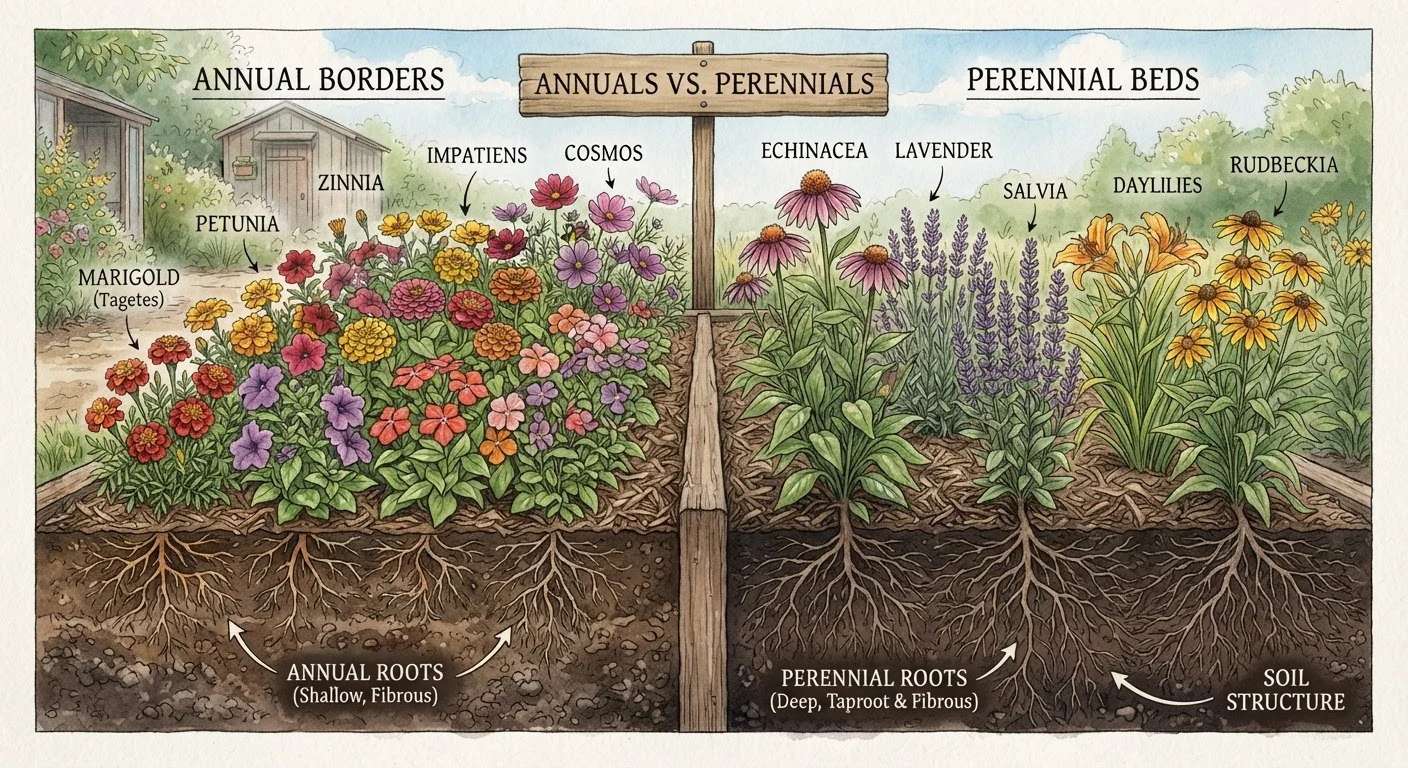
Photo credit: InsightsGrove.com | Discover Joy In Reading
In this article
Annuals bloom once; perennials return each year. Here's what that distinction means for your budget and how to plan your garden around it.
Key Takeaways
- Annuals complete their full life cycle in one growing season and must be replanted each year.
- Perennials die back in winter but regrow from established root systems each spring.
- Annuals typically cost less per plant upfront; perennials generally cost less over multiple years.
- Mixing both types lets you balance reliable structure with seasonal color flexibility.
- Perennials often spread or divide over time, giving you more plants at no added cost.
What Actually Defines an Annual or Perennial
The distinction comes down to life cycle. Annual plants germinate, grow, flower, set seed, and die within a single growing season. They put all their energy into producing blooms and seeds quickly because they have no second chance. Common examples include marigolds, zinnias, and basil.
Perennial plants live for three or more years. Above-ground growth often dies back in cold months, but the root system survives winter and pushes up new growth each spring. Think coneflowers, black-eyed Susans, and ornamental grasses.
A third category worth knowing: biennials (like foxglove and hollyhock) complete their cycle over two years - flowering in year two, then dying. They're relatively uncommon but occasionally get lumped in with perennials at garden centers, so read labels carefully.
"Hardy" vs. "Annual" on Plant Labels
Garden center tags sometimes use "tender perennial" to describe plants that are perennial in warm climates but behave like annuals in colder USDA zones. Impatiens and begonias are common examples. Always cross-check with your local hardiness zone before assuming a plant will return next year - a plant labeled perennial in Florida may not survive a Minnesota winter.
How the Costs Actually Stack Up
Annuals usually have a lower per-plant sticker price - often under a dollar per seed packet or a few dollars per six-pack of seedlings. But that cost resets every single spring. Over five years, you're paying five times.
Perennials typically cost more at purchase - a potted perennial might run $6-$15 depending on the variety and size - but that's a one-time cost per plant. Many perennials also spread through clumping or self-seeding. After two or three seasons, you can divide the plant and fill in bare spots for free.
| Criterion | Annual Plants | Perennial Plants |
|---|---|---|
| Life span | One growing season | Three or more years |
| Upfront cost per plant | Generally lower | Generally higher |
| Multi-year cost | Repeats every year | One-time investment |
| Bloom duration | Season-long, continuous | Weeks-long window per year |
| Flexibility | Full change possible each year | Fixed placement once established |
| Drought tolerance (established) | Lower - shallower roots | Higher - deeper root systems |
| Self-propagation | Self-seeds inconsistently | Clumps and divides reliably |
| Labor demand | Replanting required annually | Minimal after establishment |
If you're interested in reducing startup garden costs more broadly, see the real costs of starting a garden for a transparent breakdown. The way you source your plants also matters - seeds vs. seedlings explores whether starting from seed shifts the math further in your favor.
Performance, Flexibility, and Maintenance Trade-Offs
Annuals offer a flexibility that perennials can't match: you can completely change your garden's color scheme each year. Didn't love that shade of orange? Try something new next spring. They also tend to bloom continuously from planting through frost - a trait most perennials don't share, since perennials often have defined bloom windows of just a few weeks.
Perennials, on the other hand, reward patience. They typically underperform in year one as they establish their root systems - an old gardening saying goes: sleep, creep, leap. In year one they settle in, year two they grow modestly, and by year three they hit their stride. That patience pays dividends in reduced watering needs and lower maintenance overall once they're established.
Water use is another angle worth considering. Well-established perennials generally have deeper root systems that tolerate drought better than annuals. If keeping water costs down matters to you, smart watering strategies can help both plant types thrive while using less.
3-5 years
Typical perennial payback period vs. annuals
Most gardening educators estimate perennials break even financially within three to five seasons compared with annual equivalents, depending on the species and local plant prices.
2-4×
Division yield from a mature perennial clump
Many clump-forming perennials can be divided every two to three years, with each division producing a new full-sized plant - multiplying your original purchase at no added cost.
Building a Garden That Uses Both Strategically
Most experienced gardeners don't choose one or the other - they layer both. A common approach: use perennials as the structural backbone of a bed, then fill gaps with annuals while the perennials mature. Over a few years, as perennials spread and bulk up, you need fewer annuals to fill space.
This hybrid strategy also gives you a hedge against unpredictability. Perennials provide reliable form and return; annuals let you experiment, respond to trends, or simply brighten up a slow week in the garden.
When planning, it helps to think about this the same way you'd approach any recurring budget line - front-loading investment in things that compound over time, while keeping some flexible spending for short-term needs. The same principle that shapes long-term budgeting habits applies to a well-structured garden bed. And if you're deciding between growing setups, raised beds vs. in-ground planting covers how your container choice interacts with all of this.

Author
Home & Living Editorial Team
Home & Living Editorial Team is the collective byline for our editorial team and contributor network. Articles published under this byline or an editorial pen name are researched, written, and reviewed according to our editorial standards for clarity, consistency, and independence before publication.
View all articles →