
Toiletries and the 100ml Rule: A Practical Reference
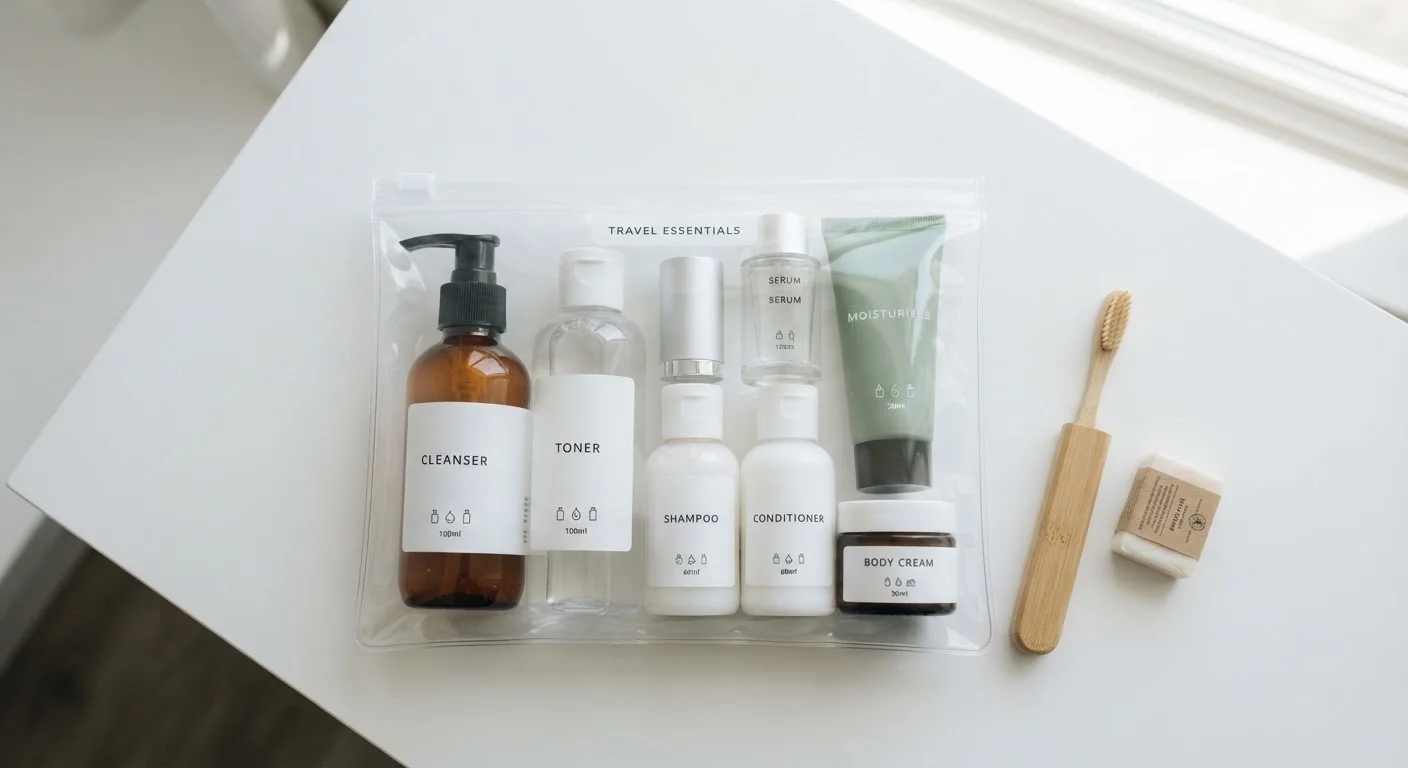
Photo credit: InsightsGrove.com | Discover Joy In Reading
In this article
A factual, easy-to-scan guide to liquid restrictions, solid alternatives, and what's typically allowed in cabin baggage.
What the 100ml Rule Actually Means
The 100ml rule — formally called the LAGs restriction — limits any single liquid, aerosol, or gel container in your carry-on to 100 millilitres (3.4 fl oz) or less. All qualifying containers must fit inside a single, resealable clear plastic bag with a maximum capacity of one litre. Most airports enforce one bag per passenger.
| Maximum container size (LAGs) | 100ml (3.4 fl oz) per container (TSA and equivalent international authorities) |
| Bag limit per passenger | One resealable clear plastic bag (Standard across US, EU, UK, Canada, Australia) |
| Bag maximum capacity | 1 litre (Standard international guidance) |
| Does fill level matter? | No — container size determines compliance, not remaining volume |
| Solid toiletries subject to LAGs? | Generally no — bars, sticks, and powders are typically unrestricted (Verify with your carrier) |
| Prescription liquid exemption | Usually allowed in quantities needed for journey; declaration may be required (Confirm with the relevant authority before travel) |
This rule applies at security checkpoints across the United States, the European Union, the United Kingdom, Canada, Australia, and most other major aviation markets — though implementation details can vary. Always verify current requirements with your airline and the official transport security authority for each country you depart from. Rules are occasionally updated, and individual airports may apply temporary exceptions or stricter measures.
A common misconception: the restriction is based on container size, not volume remaining. A 200ml bottle that is 90% empty will still be confiscated. Decanting products into containers of 100ml or less is the only workaround.
What Counts as a Liquid, Aerosol, or Gel
The LAGs category is broader than most travellers expect. If a substance flows, spreads, or sprays, it almost certainly falls under the restriction.
- Liquids: water, juice, mouthwash, contact lens solution, perfume, cologne
- Aerosols: deodorant spray, dry shampoo, hairspray, sunscreen spray
- Gels: toothpaste, hair gel, face moisturiser, hand sanitiser, aloe vera gel
- Pastes: some lip balms, thick face masks
- Creams and lotions: body lotion, foundation, sunscreen lotion
LAGs
Acronym for Liquids, Aerosols, and Gels — the collective term used by aviation security authorities to describe substances subject to the 100ml carry-on restriction.
One-litre bag
A single, transparent, resealable plastic bag with a capacity not exceeding one litre (approximately 20cm × 20cm). All LAGs containers must fit inside this bag for security screening.
Decanting
Transferring a product from its original, oversized container into a smaller travel-sized container of 100ml or less to comply with carry-on liquid rules.
Solid toiletry
A toiletry product in bar, tablet, or powder form that contains no free liquid and is therefore not subject to LAGs restrictions. Examples include shampoo bars, soap bars, and toothpaste tablets.
Exempt liquids
Liquids that are typically allowed in carry-on in quantities exceeding 100ml, such as prescription medications, baby formula, and breast milk. These usually require declaration at the security checkpoint; rules vary by country.
Items that are typically not restricted include solid bar soap, solid shampoo bars, powder-based cosmetics, mascara wands (the product itself may be classed as a gel — check with your airline), and solid deodorant sticks. Prescription liquids, baby formula, and breast milk are generally exempt from the 100ml cap but may require documentation or declaration at the checkpoint. Always confirm exemption requirements with the relevant authority before travel.
Solid Alternatives That Skip the Rule Entirely
Switching to solid-format toiletries eliminates the LAGs headache entirely and often reduces weight and bulk — a double win for carry-on-only travel. See our carry-on-only travel guide for the full packing strategy.
| Liquid Version | Solid Alternative | LAGs Exempt? |
|---|---|---|
| Liquid shampoo | Shampoo bar | Yes |
| Body wash | Bar soap | Yes |
| Spray deodorant | Solid stick deodorant | Yes |
| Shaving foam | Shaving soap / bar | Yes |
| Toothpaste | Toothpaste tablets | Yes |
| Moisturiser | Solid lotion bar | Yes |
Solid alternatives have expanded significantly in recent years and are widely available at general retailers. They also tend to last longer per use than their liquid counterparts, which can reduce the cost per trip. For more ways to cut overall travel spend, visit our Travel Money Tips hub.
Building a Minimal, Rule-Compliant Toiletry Kit
A practical carry-on toiletry kit should serve the entire trip without exceeding the one-litre bag limit. The goal is to bring only what you'll actually use, not a scaled-down version of your entire bathroom cabinet.
Buying at Your Destination Can Be Cheaper
For trips of three nights or more, purchasing shampoo, conditioner, or sunscreen after arrival is often more cost-effective than packing miniature versions. Most urban destinations have supermarkets, pharmacies, or convenience stores within reasonable distance of accommodation. Factor in local pricing before assuming travel-size products are the economical choice.
Step 1 — Audit first. Before packing anything, list every product you intend to bring and flag which are LAGs. Run a pre-trip packing audit to cut the list to essentials.
Step 2 — Go solid where practical. Replace spray deodorant with a stick, liquid shampoo with a bar. Each swap frees up space in your one-litre bag for items that only exist in liquid form.
Step 3 — Decant, don't buy full-size travel packs. Decanting into small reusable containers is generally more cost-effective than repeatedly purchasing branded travel-size products. Reusable silicone containers in 30ml, 50ml, and 100ml sizes cover most needs.
Step 4 — Factor in your destination. If you're travelling to a destination with reliable access to shops, consider buying bulky or heavy liquids (shampoo, conditioner, sunscreen) on arrival rather than packing them at all. This is particularly practical for trips longer than a few days. For guidance on whether to check a bag instead, see Checked Bag vs. Carry-On: Which Costs You Less.
For a broader packing framework, the Complete Guide to Travelling Light on Any Budget covers bag selection, clothing strategy, and common fee traps alongside toiletry decisions.
Note: Security rules and airline policies change. Always verify current requirements with the relevant official transport security authority and your carrier before you travel.

Author
Travel Smarter Editorial Team
Travel Smarter Editorial Team is the collective byline for our editorial team and contributor network. Articles published under this byline or an editorial pen name are researched, written, and reviewed according to our editorial standards for clarity, consistency, and independence before publication.
View all articles →