
Multifunctional Furniture Worth Understanding Before You Buy
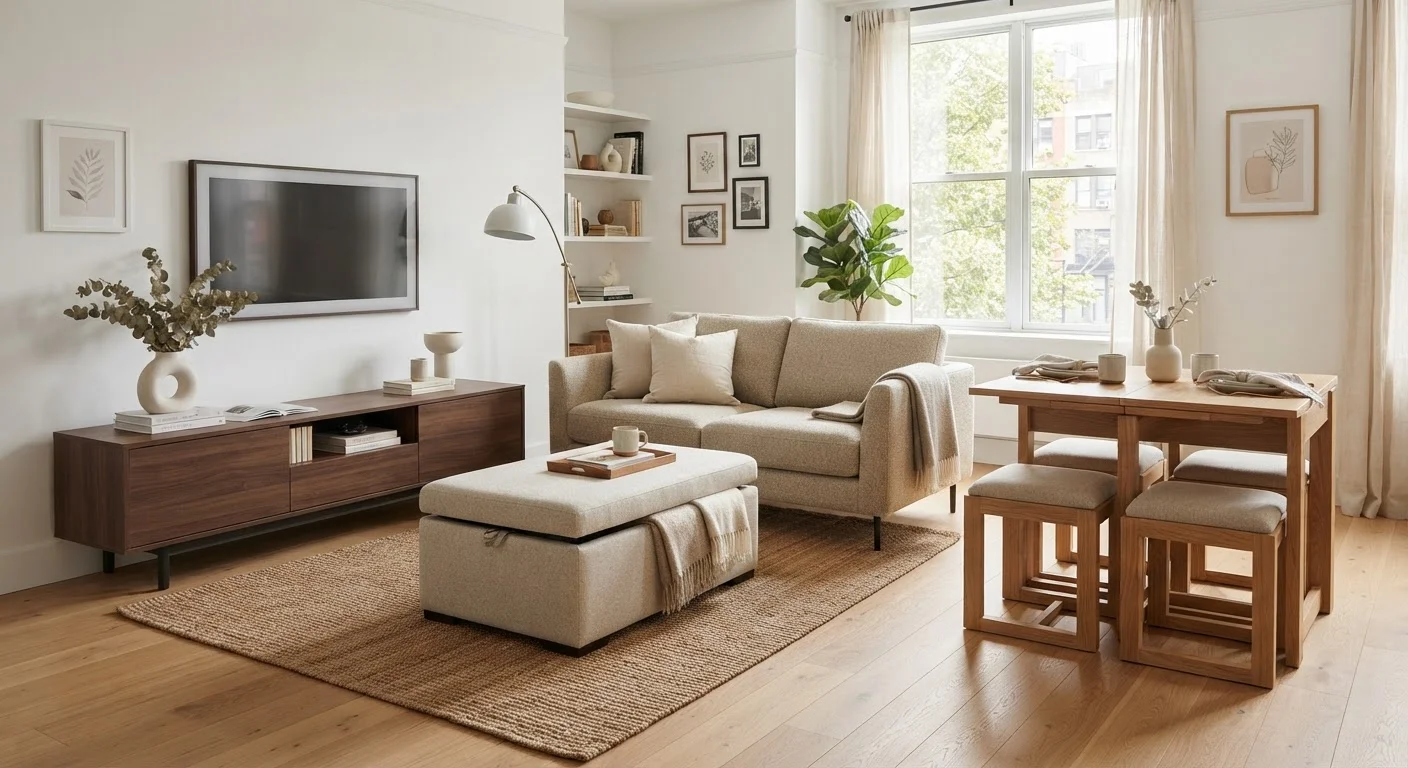
Photo credit: InsightsGrove.com | Discover Joy In Reading
In this article
Ottoman storage, extendable dining tables, nesting stools — learn what each type actually does, its limitations, and which spaces suit it best.
What Multifunctional Furniture Actually Means
Multifunctional furniture refers to pieces designed to serve two or more distinct uses - a sofa that unfolds into a bed, a coffee table with interior storage, or a dining table that contracts to half its size. The category is broad, and that breadth is part of the problem. Not every piece that claims multiple functions delivers on all of them equally well.
Before buying, it helps to categorize the type of function you need. There are three core patterns:
- Storage-integrated seating - ottomans, benches, and poufs with hollow interiors
- Scalable surfaces - extendable, folding, or nesting tables and stools
- Convertible sleeping or seating - sofa beds, daybeds, murphy beds, and futons
Each pattern solves a different problem. Understanding which one matches your actual constraint is the first step. If your issue is clutter, storage seating helps. If you host occasional guests in a studio, a convertible sleeping piece matters more. If you cook for varying numbers, scalable dining surfaces earn their keep.
For a broader framework on how to think about space before any purchase, see the small-space living guide.
| Primary categories | Storage-integrated seating, scalable surfaces, convertible sleeping/seating |
| Murphy bed installation | Typically requires wall mounting; rental approval often needed |
| Sofa bed trade-off | Shallower seat depth than dedicated sofas; thinner mattress than standalone beds |
| Drop-leaf benefit | No loose-leaf storage required; folds flat when not in use |
| Key buying question | Does the piece succeed at its primary function before its secondary one? |
Type-by-Type Breakdown: What Each Piece Does and Doesn't Do
Storage Ottomans - These double as a footrest, informal seat, and closed storage container. They work well for items you need to access occasionally but not daily: extra blankets, board games, charging cables. The limitation is access - you can't reach the interior without clearing whatever is on top. They also don't work as a primary seat for extended periods. More on this storage approach in overlooked storage spots.
Extendable Dining Tables - Extension mechanisms (butterfly leaf, draw-leaf, drop-leaf) let tables grow from a compact footprint to full size when needed. The practical constraint is the extension itself: leaves require somewhere to store them when not in use, and butterfly mechanisms add mechanical parts that can loosen over time. A drop-leaf table avoids the loose-leaf storage problem but can feel visually unbalanced when fully extended.
Nesting Tables and Stools - These stack inside each other, saving floor space until needed. They're genuinely useful for flexible seating or surface area during gatherings. Trade-off: individual pieces tend to be lighter, which can feel less stable, and the smallest unit in a nesting set is often too low for comfortable adult use.
Sofa Beds and Futons - Convertible sleeping pieces are the most common multifunctional purchase and also the most frequently disappointing. As a sofa, most sofa beds have shallower seat depth than a dedicated couch. As a bed, the mattress is thinner and firmer than a standalone option. They make sense when guest sleeping is infrequent. For a comparison of sleeping surface trade-offs, mattress type differences is worth reading before committing to a pull-out.
Murphy Beds (Wall Beds) - Murphy beds fold flat against the wall when not in use, freeing the full floor area of a room during the day. They require wall mounting, which typically needs landlord approval in a rental and, depending on weight and mechanism, may require a licensed installer. They're not a DIY project for most people.
Butterfly leaf
A table extension mechanism where a folded panel is stored under the tabletop and unfolds upward to fill a gap when the two halves of the table are pulled apart. No separate leaf storage is needed.
Drop-leaf
A hinged table or counter section that folds down when not needed, reducing the table's footprint. The leaf is attached to the frame and requires no separate storage.
Murphy bed
A bed mounted on a hinged frame that folds up and stores vertically against a wall or inside a cabinet when not in use. Also called a wall bed.
Nesting furniture
A set of identically shaped but graduated-size pieces - tables or stools - designed to stack inside one another for compact storage when the full set isn't needed.
Convertible furniture
Any piece that mechanically transforms between two distinct configurations, such as a sofa that unfolds into a bed or a bench that opens for storage.
Matching the Piece to the Space - and the Reality Check
The most common mistake is buying multifunctional furniture to solve a problem the piece wasn't designed for. A storage ottoman doesn't replace a linen closet. A futon doesn't replace a proper guest room. Before purchasing, run through three questions:
- What is the primary use? If a piece fails at its main job, the secondary function doesn't compensate.
- How often will you actually convert or access it? A murphy bed used nightly is worth the installation complexity. One used twice a year probably isn't.
- Does the footprint when deployed fit your space? An extendable table might seat eight - but does your room have room for eight chairs?
It's also worth auditing what you already own before adding more. The room-by-room audit checklist is a practical way to identify what's already earning its space versus what's simply taking it up.
Finally, multifunctional furniture isn't always a substitute for rethinking where storage lives. vertical storage strategies can solve clutter problems that no ottoman will fix, and avoiding unnecessary storage purchases is covered in detail in the article on storage product myths.
~350 sq ft
Average US studio apartment floor area
According to U.S. Census Bureau data on new residential construction, studio units typically average around 350 square feet - a scale where every furniture decision has measurable impact.
2-3 uses
Functions claimed by most convertible furniture
Most multifunctional pieces are marketed as serving two to three roles; in practice, secondary and tertiary functions are often used far less frequently than primary ones.

Author
Home & Living Editorial Team
Home & Living Editorial Team is the collective byline for our editorial team and contributor network. Articles published under this byline or an editorial pen name are researched, written, and reviewed according to our editorial standards for clarity, consistency, and independence before publication.
View all articles →