
Progressive Overload Without Weights: Keeping Your Home Workouts Challenging
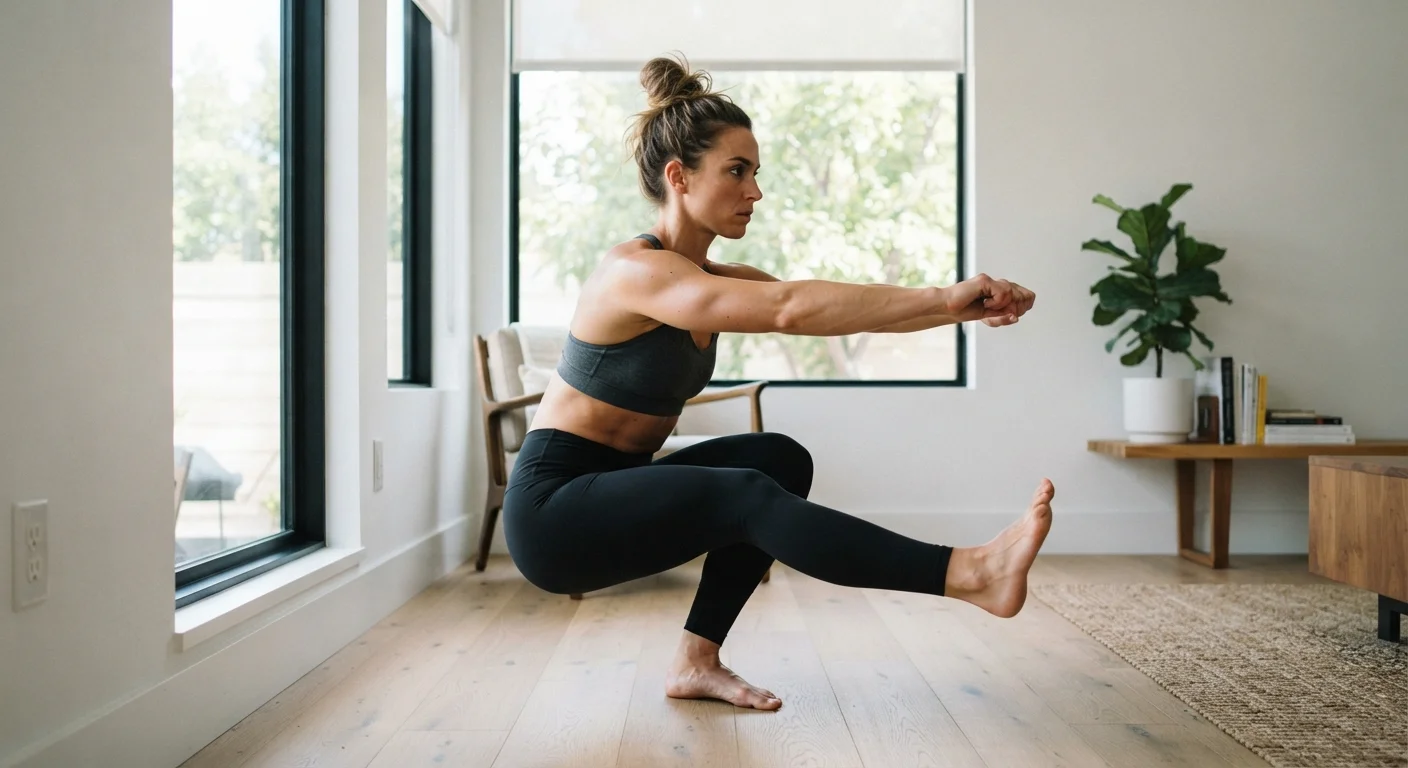
Photo credit: InsightsGrove.com | Discover Joy In Reading
In this article
Learn how to keep making fitness progress at home by applying progressive overload principles — no dumbbells or machines required.
Key Takeaways
- Progressive overload means systematically increasing workout demand over time - no weights required.
- Variables like reps, tempo, rest periods, and leverage all serve as effective overload tools.
- Tracking your sessions in a simple log is essential to knowing when and how to progress.
- Harder exercise variations replace heavier weights as the primary progression mechanism.
- Rest and recovery are non-negotiable parts of any effective overload strategy.
Why Progressive Overload Works Without Weights
A common misconception - addressed directly in our breakdown of home fitness myths - is that building strength or muscle requires gym equipment. The underlying physiology doesn't distinguish between a barbell and the mechanical tension produced by a well-executed single-leg squat. What muscles respond to is sufficient challenge relative to current capacity.
Progressive overload is the mechanism that keeps that challenge growing. Research consistently supports that manipulating training variables - volume, intensity of effort, tempo, and exercise complexity - can drive meaningful adaptation in the absence of external load, provided the stimulus is progressively increased over time.
For budget-conscious adults exercising at home, this is practically significant: no ongoing equipment costs, no gym membership, and no ceiling on progress if the approach is structured intelligently. If you're newer to home training, our beginner's guide to home fitness covers the foundations before applying any overload strategy.
This Is General Fitness Information
The guidance in this article is educational and intended for generally healthy adults. It is not a substitute for personalised advice from a qualified fitness or healthcare professional. If you have an injury, chronic condition, or are new to exercise, consult a professional before beginning any new training program.
How to Apply Progressive Overload Step by Step
The steps below give you a structured framework for introducing progressive overload into any bodyweight routine. They're ordered by accessibility - starting with the tools that require the least technical skill and building toward the most powerful long-term strategies.
What you will need
Workout log (notebook or free app)
Records sets, reps, tempo, and rest times so you can identify when to progress.
Timer or stopwatch
Controls rest intervals and tempo precisely - both critical overload variables.
Resistance band (light)
Adds load or assistance to bodyweight movements as an optional bridge between progressions.
Sturdy chair or low step
Enables elevated or deficit push-up and split-squat variations that increase difficulty.
Understand the Core Principle
Progressive overload is the practice of gradually increasing the demand placed on your muscles and nervous system over time. Without it, your body adapts to a given stimulus and stops developing strength or endurance. With weights, the simplest version is adding more plates. Without weights, you manipulate other variables to achieve the same effect.
The key variables available to you are: volume (total reps and sets), intensity of effort (how close to failure you train), tempo (how fast or slow each rep is), rest duration, and exercise variation (harder versions of a movement). Changing any one of these meaningfully increases the challenge.
Establish a Baseline With Your Current Workout
Before you can progress, you need to know where you stand. Perform your current routine and record every set: exercise name, reps completed, rest time taken, and any notes on difficulty. Aim to reach a point in each set where you have roughly 2-3 reps left in reserve - meaning you could do 2 or 3 more if you had to. This is your working baseline.
Do this for at least one full week before applying any overload. Trying to progress from a poorly understood baseline leads to random changes rather than structured improvement.
Apply Volume Overload First
The most straightforward starting point is adding reps or sets. If you completed 3 sets of 10 push-ups comfortably this week, aim for 3 sets of 12 next week - or add a fourth set at the same rep count. Volume increases are sustainable early in a training block and don't require learning new movements.
A practical ceiling: once you can complete an exercise for more than about 20-25 clean reps per set, adding more reps offers diminishing returns. That's your signal to shift to a harder variation rather than just doing more of the same thing.
Use Tempo to Increase Muscular Demand
Slowing down a repetition increases the time your muscle is under tension, which is a well-established driver of strength and hypertrophy adaptations. A standard push-up might take 1 second down, 1 second up. A 3-1-3 tempo (3 seconds lowering, 1 second pause, 3 seconds pushing) turns the same exercise into a significantly harder stimulus - without changing the movement or adding load.
Apply tempo changes to the lowering phase (eccentric) first, as muscles are generally stronger in that direction and the technique is easier to control. A 3-5 second descent is a practical, evidence-informed range to work within.
Shorten Rest Periods Strategically
Reducing rest time between sets increases cardiovascular and metabolic demand on the same exercise. If you currently rest 90 seconds between squat sets, dropping to 60 seconds is a legitimate and measurable overload. Do this after you've stabilised your rep performance - not as your first tool, since insufficient rest can compromise form before muscles are the limiting factor.
Work toward a rest period appropriate to your goal: shorter rests (45-60 seconds) suit muscular endurance and conditioning; longer rests (90-120 seconds) better support strength-focused work.
Progress to Harder Exercise Variations
This is the most powerful long-term tool. When volume and tempo adjustments are no longer providing challenge, move to a mechanically harder version of the same movement pattern. Common progressions include:
- Push-up progressions: standard → close-grip → decline → archer → single-arm negatives
- Squat progressions: two-leg squat → Bulgarian split squat → skater squat → pistol squat
- Hinge progressions: glute bridge → single-leg glute bridge → Nordic hamstring curl (with a partner or anchor)
- Pull progressions: doorframe rows → Australian pull-ups (using a table) → full pull-ups if a bar is available
Each variation shifts leverage or reduces stability, effectively increasing the load your muscles must manage without adding external weight. See our comparison of bodyweight and resistance band training if you want to explore adding minimal equipment at this stage.
Schedule and Protect Your Recovery
Progressive overload creates the stimulus for adaptation, but adaptation happens during recovery. Without adequate rest, repeated hard sessions lead to plateaus or regression rather than improvement. Plan at least one full rest day between sessions targeting the same muscle groups. Understanding how rest days function as a training tool is essential - not optional - for anyone applying overload principles.
Sleep quality, nutrition adequacy, and overall stress levels all affect recovery rate. These are factors worth monitoring alongside your workout log.
Use a Simple Notebook or Free App
You don't need specialized software to track progress. A basic notebook or free notes app works perfectly. Log the exercise, sets, reps, tempo, and rest time after every session. Patterns become visible within weeks, making it far easier to decide when to apply the next overload variable.
Don't Skip the Warm-Up
Jumping into harder variations or faster tempos without preparing your joints and muscles raises injury risk significantly. Spend at least five minutes mobilising before each session. If an exercise causes sharp or joint pain - as opposed to normal muscular effort - stop and seek professional guidance.
For a full framework on how to structure these principles across a training week, see our guide to building a weekly workout routine without equipment. And if limited floor space is a constraint, small-space fitness strategies can help you adapt these progressions to your environment.
This article is for general informational and educational purposes only and does not constitute medical or fitness advice. Consult a qualified healthcare or fitness professional before beginning any new exercise program, particularly if you have a pre-existing health condition or injury.

Author
Health & Wellness Editorial Team
Health & Wellness Editorial Team is the collective byline for our editorial team and contributor network. Articles published under this byline or an editorial pen name are researched, written, and reviewed according to our editorial standards for clarity, consistency, and independence before publication.
View all articles →