
The Anatomy of a Fake Sale: How Retailers Inflate 'Original' Prices
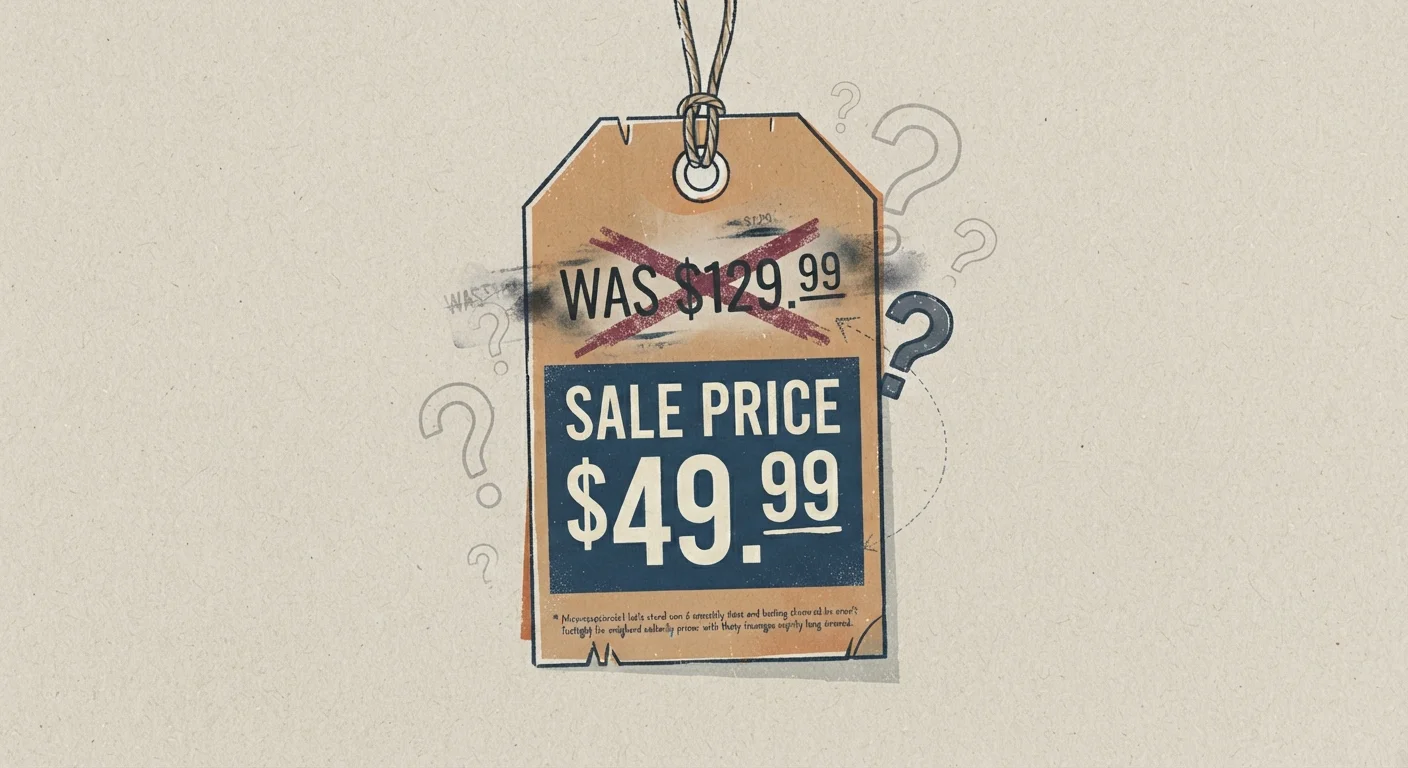
Photo credit: InsightsGrove.com | Discover Joy In Reading
In this article
Learn how artificially inflated reference prices make discounts look bigger than they are — and how to see through the tactic.
Key Takeaways
- A high 'original' price is only meaningful if customers actually paid it regularly and recently.
- Retailers can legally post an inflated reference price if it was offered for even a short window.
- Price history tools let you verify what a product actually sold for over time.
- Percentage-off claims are only as credible as the baseline price they reference.
- Regulatory protection exists but is unevenly enforced - consumer vigilance matters.
How the Illusion Gets Built
Every fake sale follows a predictable blueprint. A retailer sets - or simply lists - a product at an elevated price point. It may stay there for a few days, or it may never be the price a customer actually paid at checkout. Then comes the markdown: a bold red number, a percentage badge, a countdown timer. The gap between the two prices is the illusion.
The mechanism relies on what behavioral economists call the anchor effect: the first number a person sees disproportionately shapes their perception of value. When shoppers see "Was $180, Now $89," the $180 becomes the mental benchmark - even if the product's genuine market value is closer to $85. The discount feels real because the comparison feels real.
What makes this especially effective is that it exploits a reasonable assumption: that listed prices reflect what people actually paid. In practice, there is no legal requirement in the US for a 'former price' to have been widely transacted - only that it was offered at some point. A 48-hour listing at an inflated price can be enough to justify months of "sale" framing.
“The reference price is the most powerful number in retail. Consumers don't evaluate prices in absolute terms - they evaluate them relative to whatever anchor was set first.”
— Richard Thaler, Nobel Prize-winning economist and co-author of 'Nudge'
The Mechanics Retailers Actually Use
Understanding the specific techniques helps you spot them faster. The most common include:
- Phantom original prices: The item is listed at a high price briefly - sometimes only online - then permanently sold at the lower "sale" price. The original was never a realistic transaction price.
- MSRP anchoring: The Manufacturer's Suggested Retail Price is used as the reference, even when no retailer actually charges it. MSRP is a ceiling, not a baseline.
- Cyclical markdowns: A product cycles between a high and low price on a predictable schedule. It's always "on sale" because the elevated price only exists to enable the markdown.
- Bundle reference inflation: A bundle's "combined value" is calculated using inflated individual prices for items that were never sold separately at those figures.
These aren't fringe tactics - they appear regularly during major shopping events. A closer look at major sale events shows how discount depth varies and where manufactured markdowns are most common.
87%
UK products 'on sale' before Black Friday at lower price
A Which? investigation found that 87% of Black Friday 'deals' in a studied sample were available at the same price or lower at other points in the preceding six months.
~40%
Shoppers who check price history before buying
Consumer surveys consistently suggest a minority of shoppers verify historical prices before acting on a sale claim, leaving most vulnerable to anchor pricing.
What You Can Actually Do About It
The most effective counter to artificial reference pricing is price history verification. Browser extensions and price-tracking services record what a product actually sold for over time, letting you see whether the current "sale" price is genuinely lower than the norm or simply the standard price relabeled. Price history tools and their limitations are worth understanding before you rely on them.
Check Price History Before Acting on Any 'Sale'
Install a price-tracking browser extension and check a product's 30- to 90-day price chart before purchasing anything flagged as discounted. If the 'sale' price matches the item's typical price over that window, the discount is not meaningful. A few seconds of verification can prevent a purchase driven entirely by an artificial anchor.
Beyond tools, ask two grounding questions before acting on a sale: Was this price real for real customers? and Is this price lower than what competitors charge right now? A genuine discount answers yes to both. A manufactured one usually can't.
Also be aware that the tactics extend beyond the price tag. Urgency language, low-stock warnings, and exclusive-member framing are often layered on top of inflated reference prices to compress decision time. Psychological pricing tactics covers these in more detail. For a broader foundation, finding genuine discounts is a practical starting point for building durable shopping habits.
Frequently Asked Questions

Author
Savvy Shopping Editorial Team
Savvy Shopping Editorial Team is the collective byline for our editorial team and contributor network. Articles published under this byline or an editorial pen name are researched, written, and reviewed according to our editorial standards for clarity, consistency, and independence before publication.
View all articles →