
Robot Vacuum vs. Traditional Vacuum: Which Fits Your Home?
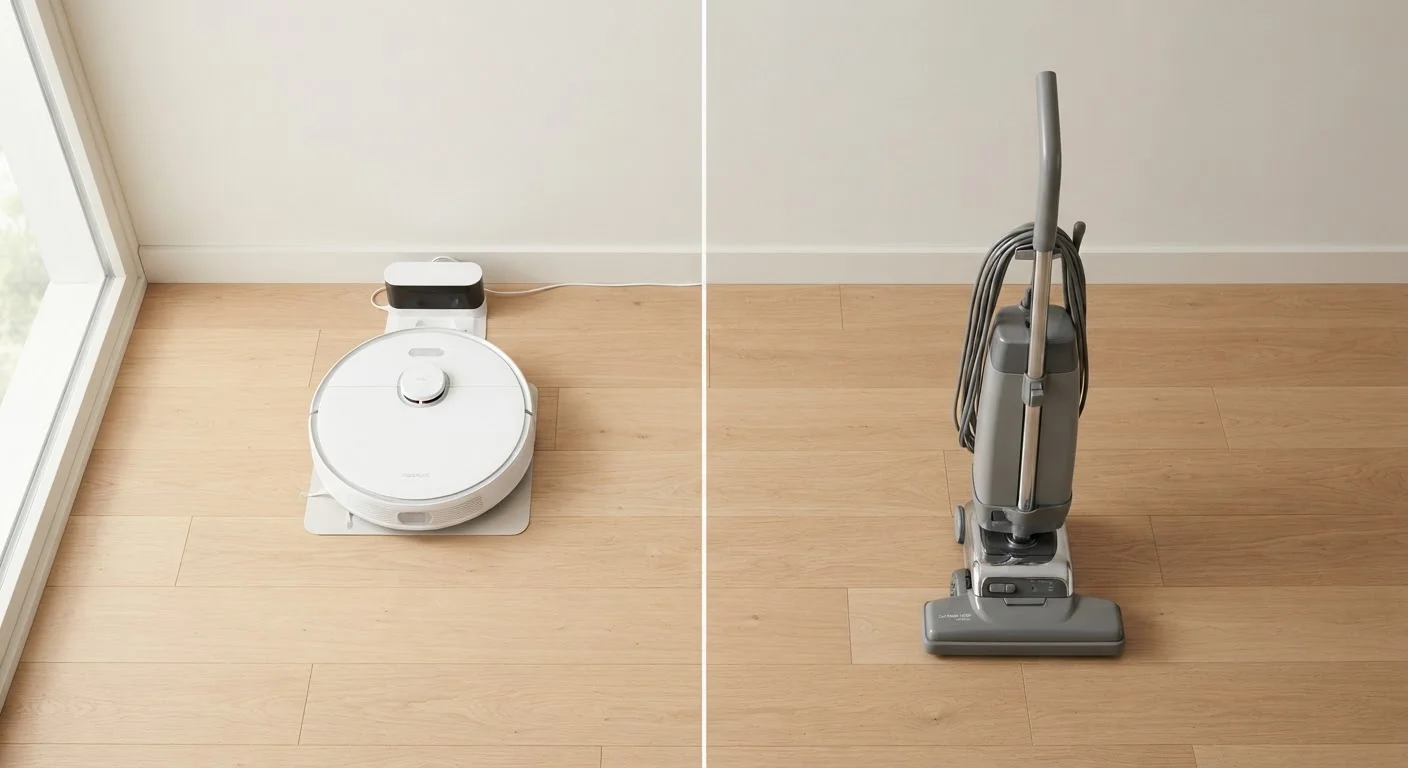
Photo credit: InsightsGrove.com | Discover Joy In Reading
In this article
A side-by-side look at robot and traditional vacuums across floor types, pet hair, budget, and real-world convenience.
Key Takeaways
- Robot vacuums excel at frequent light cleaning but generally cannot match traditional vacuums for deep carpet cleaning.
- Traditional vacuums typically offer stronger suction and more versatile attachments for tackling varied messes.
- Robot vacuums carry a higher upfront cost for equivalent performance and require periodic maintenance of their sensors and brushes.
- Pet hair households may find either type works - but the right choice depends heavily on floor type and hair volume.
- Neither type is universally superior; your floor plan, lifestyle, and budget all drive the better pick.
How They Actually Clean: Mechanics and Suction
Robot vacuums navigate autonomously using sensors - some use lidar mapping, others use bump-and-go patterns - picking up surface debris as they pass. They work best on hard floors and low-pile carpets. Their suction is generally measured in pascals (Pa), and while higher-end models approach the performance of entry-level traditional vacuums, most still fall short on deep carpet agitation.
Traditional vacuums - whether upright, canister, or stick - are operator-guided and typically deliver stronger, more focused suction. The motorized brush roll on most uprights actively works debris out of carpet fibers in a way that robot vacuums' smaller rollers cannot replicate. For hardwood or tile, both types perform acceptably; for medium- or high-pile carpet, the difference is more pronounced.
| Criterion | Robot Vacuum | Traditional Vacuum |
|---|---|---|
| Suction power | Moderate (varies widely by model) | Strong to very strong |
| Deep carpet cleaning | Limited on high-pile | Effective across pile heights |
| Hard floor performance | Good to excellent | Good to excellent |
| Automation | Scheduled, hands-free runs | Manual operation required |
| Stair cleaning | Not capable | Yes, with attachments |
| Upholstery/spot cleaning | Not capable | Yes, with attachments |
| Entry-level price range | ~$150-$300+ | ~$80-$200 |
| Ongoing maintenance | Bin, brush roll, filters, battery | Bag/bin, filters, brush roll |
Real-World Convenience: Automation vs. Control
The headline appeal of robot vacuums is automation. You set a schedule, and the floor gets swept - without your involvement. That said, they demand their own kind of maintenance: emptying the dustbin every few runs, cleaning brush rolls tangled with hair, and occasionally recalibrating maps when furniture moves. Models with self-emptying bases shift some of that work, but add significantly to the price.
Traditional vacuums require your time but give you direct control. You can concentrate suction on a specific spot, swap attachments for upholstery or stairs, and see exactly what you're picking up. For households with clutter on the floor, pets, or irregular room layouts, that control often proves more practical than the automation promise. The trade-off, as with most automation decisions, mirrors broader themes explored in our look at automating routine tasks - convenience gains can come with hidden oversight costs.
~40%
US households with a robot vacuum
Consumer Electronics Association surveys indicate roughly 4 in 10 US vacuum-owning households have tried or own a robot vacuum, though adoption varies widely by income bracket.
2-3x
Typical robot vs. traditional vacuum price gap
At equivalent performance tiers, robot vacuums generally cost two to three times more than comparable traditional models, based on major retailer pricing surveys.
Pet Hair, Floor Types, and Edge Cases
Pet owners face a specific challenge: high volumes of fine hair that wraps around brush rolls and clogs filters. Robot vacuums can handle daily shedding on hard floors reasonably well, but the bin fills fast and the brush roll needs frequent clearing - sometimes after every run. If your pet sheds heavily onto thick carpet, a traditional vacuum with a tangle-resistant brush roll is generally more effective and less fussy to maintain.
Floor type is the single biggest factor in this comparison. Open-plan homes with mostly hardwood or tile floor large enough for a robot to navigate cleanly are the ideal environment for robot vacuums. Multi-level homes, stairs, rooms packed with furniture legs, or spaces with dark rugs (which can confuse optical sensors) limit a robot vacuum's effectiveness significantly. Traditional vacuums handle all these scenarios without issue. If you're weighing where to purchase either type, our guide on online vs. in-store shopping can help you evaluate where you'll get the most reliable product information before buying.
Sensor Limitations Worth Knowing
Most robot vacuums use infrared or optical sensors that can struggle with very dark floors or rugs, misidentifying them as drop-offs and avoiding the area entirely. Before purchasing a robot vacuum, check whether the model has been tested on floor colors and materials similar to yours. Manufacturer specs rarely flag this limitation prominently.
Cost of Ownership Beyond the Sticker Price
Entry-level robot vacuums start around $150-$200 but often lack reliable mapping or adequate suction. Models with consistent performance and app-based scheduling typically start closer to $300. Self-emptying models push well past $500. By contrast, capable traditional uprights are widely available in the $80-$200 range, with filters and bags as the primary ongoing cost.
Both types require filter replacements and brush roll cleaning. Robot vacuums add the potential cost of replacement batteries over time - typically after several years of daily use. When factoring total cost of ownership over three to five years, the gap between types narrows but rarely reverses entirely in the robot vacuum's favor unless the automation benefit holds genuine lifestyle value for your household.

Author
Savvy Shopping Editorial Team
Savvy Shopping Editorial Team is the collective byline for our editorial team and contributor network. Articles published under this byline or an editorial pen name are researched, written, and reviewed according to our editorial standards for clarity, consistency, and independence before publication.
View all articles →